
Patterns in Nature: The 10 Types and What Each One Solves
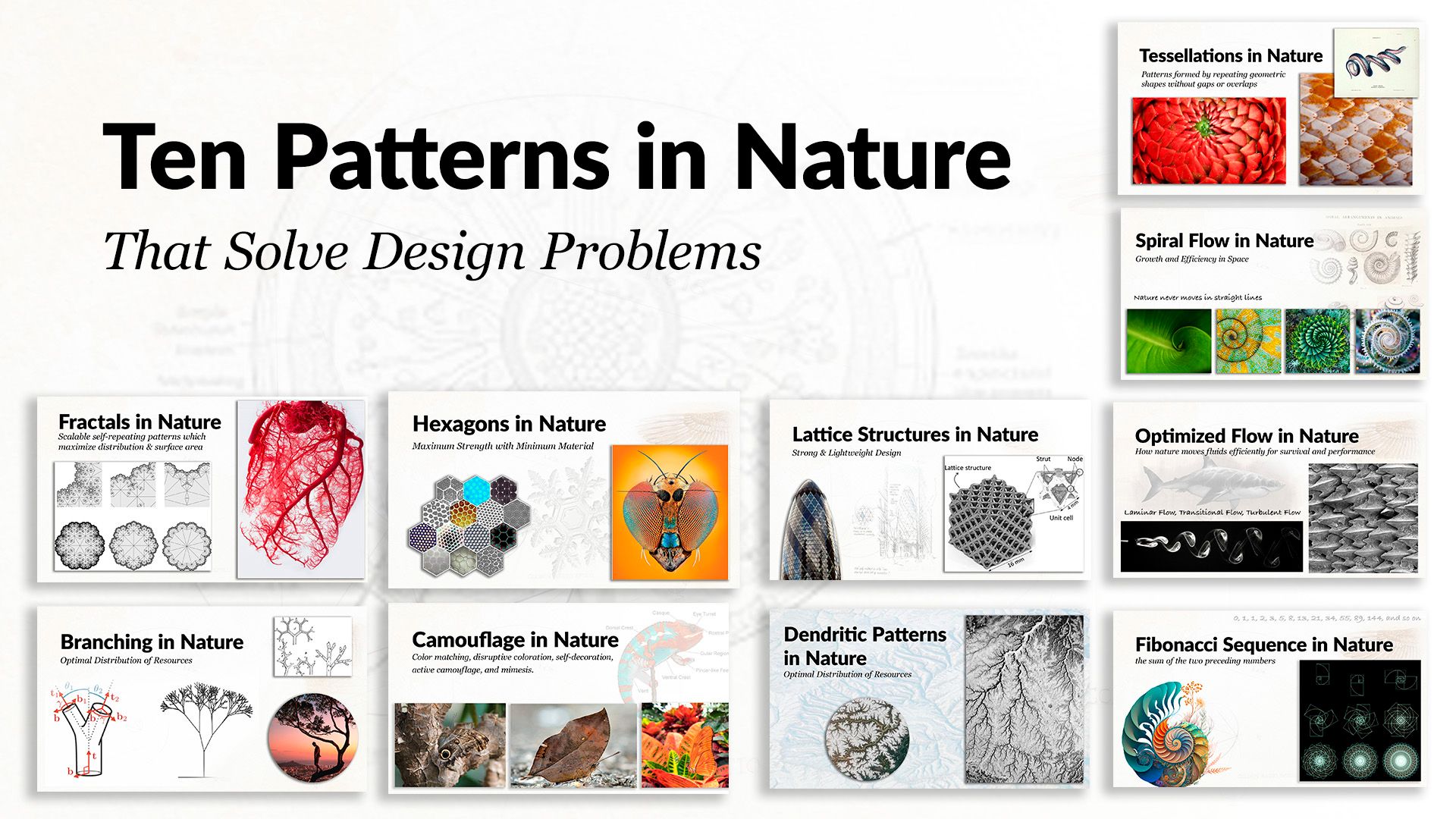
A pattern in nature is a form that repeats because it solves a problem. Spirals, hexagons, branches and fractals show up again and again across unrelated species because each one answers a physical question — how to grow, how to hold weight, how to move fluid, how to fill space without waste.
By studying natural patterns and design phenomena, we can create more efficient, sustainable, and innovative solutions in fields like engineering, architecture, and technology (and more!).
This article explores 10 patterns or design phenomena found in nature, what problem each one solves, the mathematics underneath them, and how they have been applied in real-world designs through biomimicry.
Ready to start learning biomimicry? You can download this free eBook: A Field Guide to Biomimicry. It will help you understand the basics in a single read-through and advance your career with new skills.
What is a pattern in nature?
A pattern in nature is a repeating form or arrangement that appears across living and non-living systems because it performs a function efficiently. Unlike a decorative pattern, a natural pattern is not chosen — it emerges. It is the shape that physics, chemistry and evolution converge on when a particular problem is solved under a particular set of constraints.
That is why the same pattern turns up in places with no shared ancestry. A river delta and a set of lung bronchi branch the same way, not because one copied the other, but because both are distributing a flow across an area and branching is the cheapest way to do it. A honeycomb and a basalt column both tile in hexagons, because hexagons divide a plane with the least perimeter.
For a designer, this is the useful part: if a pattern recurs, it is because it works. The pattern is a solution that has already been tested for millions of years.
New to the field? Start with what biomimicry actually is.
The 10 patterns in nature at a glance
| Pattern | What it solves | Where you see it |
|---|---|---|
| Fractals | Maximum surface area and distribution in minimum volume | Ferns, lungs, river deltas, lightning |
| Spirals | Growth without changing shape; efficient packing | Nautilus shells, sunflowers, hurricanes |
| Hexagons | Maximum strength with minimum material | Honeycomb, insect eyes, basalt columns |
| Optimised flow | Movement through air and water with least drag | Shark skin, bird wings, maple seeds |
| Branching | Distributing resources across a wide area | Trees, blood vessels, root networks |
| Tessellations | Covering a surface with no gaps or waste | Turtle shells, fish scales, pineapples |
| Lattices | Strength and flexibility at very low weight | Bird bones, sponges, dragonfly wings |
| Dendritic patterns | Efficient transport and signal transmission | Neurons, frost crystals, coral |
| Fibonacci sequence | Balanced growth and optimal seed packing | Pinecones, succulents, sunflower heads |
| Camouflage | Concealment through matching or disruption | Cuttlefish, stick insects, chameleons |
| Functional surfaces | Repelling, gripping, colouring without pigment | Lotus leaves, gecko feet, butterfly wings |
1. Fractals: Maximise Distribution & Surface Area
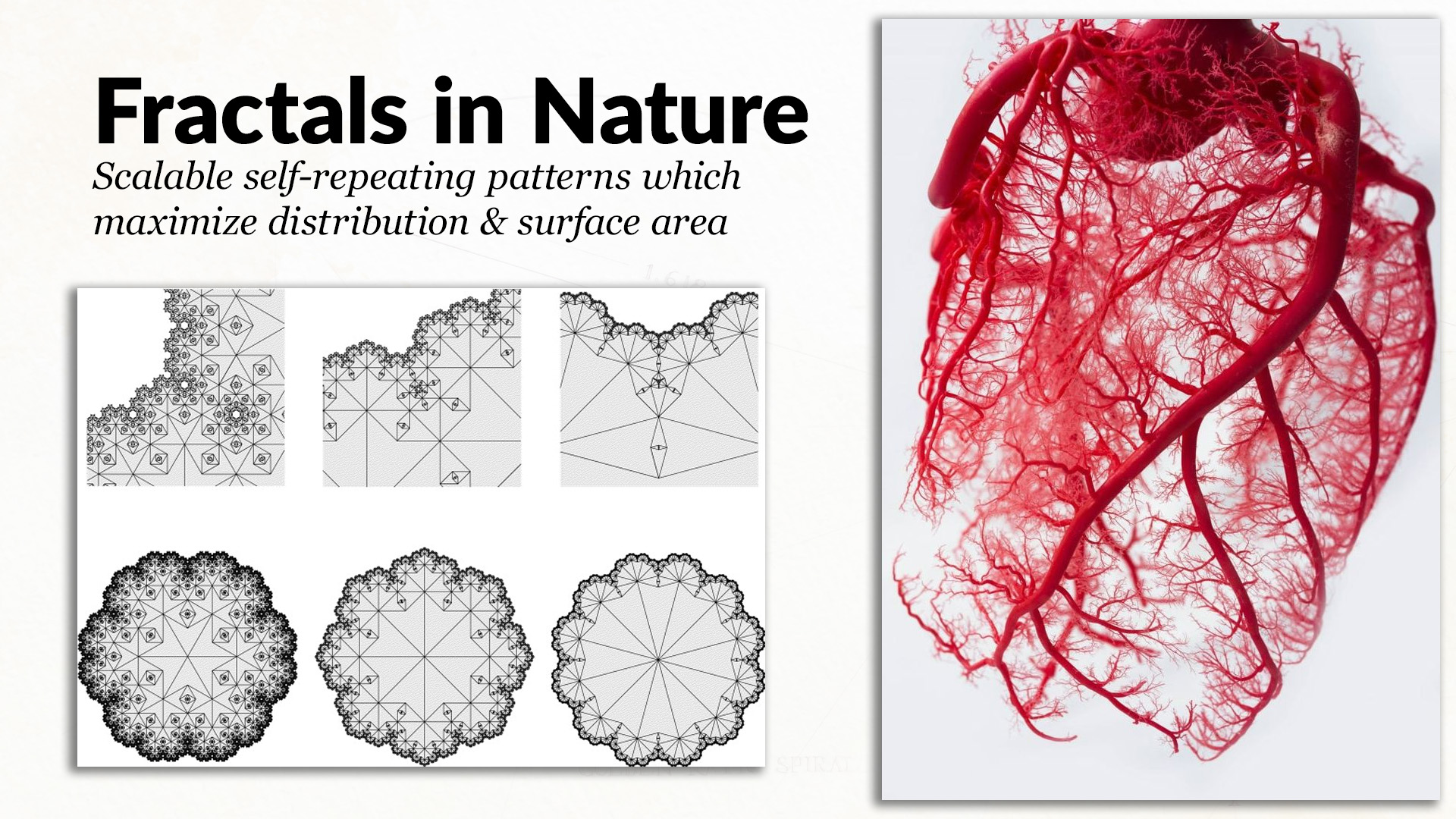
Fractals are self-repeating patterns found throughout nature. These structures maximize efficiency and adaptability. For example, trees and blood vessels use fractal branching to optimize nutrient and oxygen distribution. Fern leaves and coral formations grow in fractal patterns to maximize surface area for photosynthesis and nutrient absorption. In snowflakes and seashells, fractals contribute to structural integrity.
What makes a fractal a fractal is self-similarity: zoom in on one branch of a fern frond and it looks like the whole frond. Nature rarely repeats this infinitely — most natural fractals run to four or five iterations before physics or material cost stops them. That is enough. A human lung packs roughly 70 square metres of gas-exchange surface into the volume of a chest cavity using about 23 branching generations.
Biomimicry Applications
- Antenna Design: Fractal-inspired antennas are used for maximum signal reception by various organisations, including NASA.
- Urban Planning: Some cities, like Rome, use fractal layouts to improve traffic flow.
- Solar Panels: Leaf-inspired fractal solar panels enhance energy absorption.
2. Spiral Patterns in Nature: Growth and Efficiency in Space
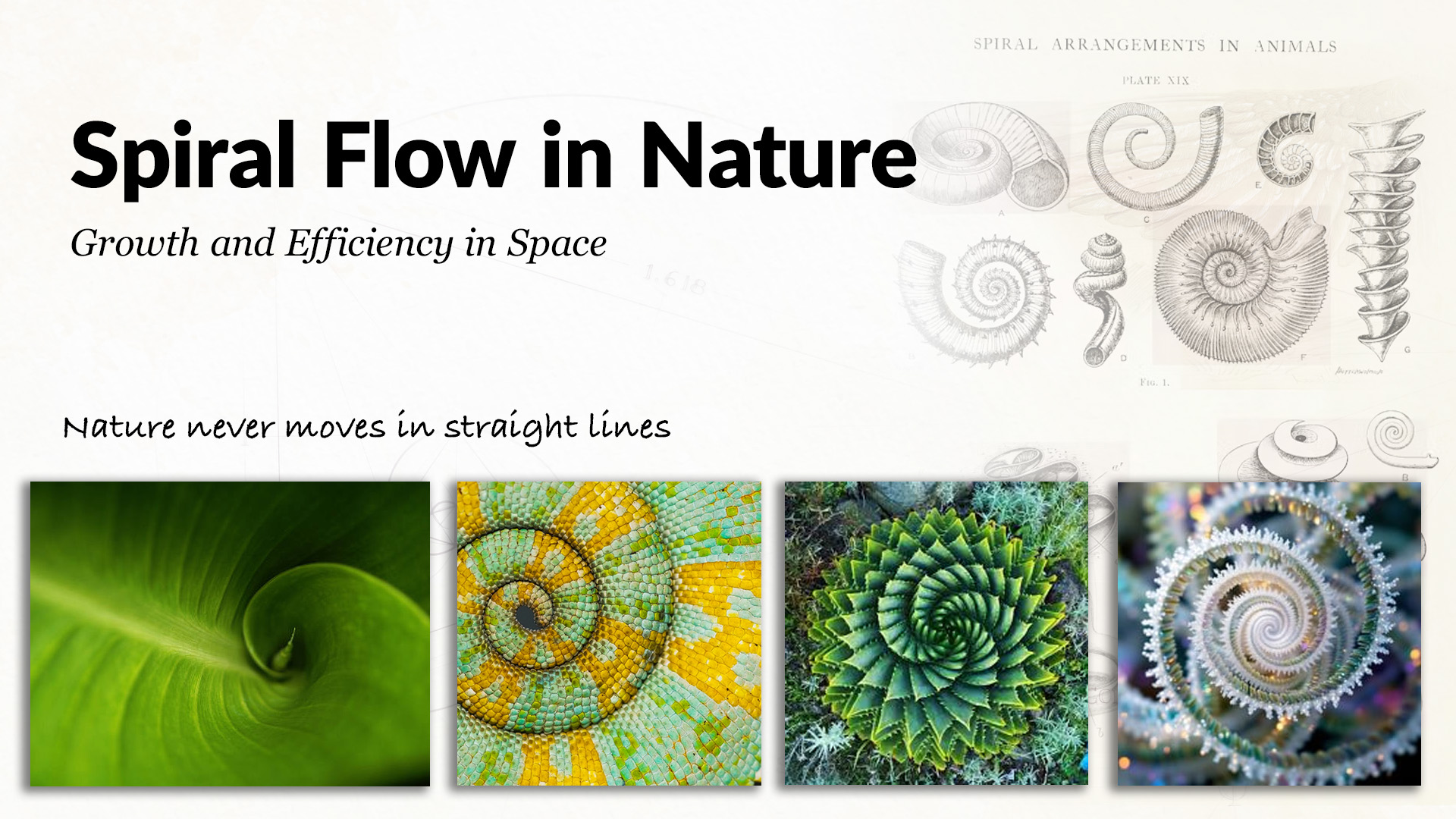
Spirals are common in nature, appearing in shells, galaxies, hurricanes, and even DNA. These patterns optimize growth, strength, and energy efficiency. For example, snail shells and nautilus shells grow in logarithmic spirals, allowing for expansion without changing shape. Sunflowers and pinecones arrange seeds in spirals to maximize space and sunlight exposure.
Tornadoes and whirlpools use spiral dynamics to channel energy efficiently. In animals, spiral body structures, like a seahorse’s curled tail, provide grip and stability. By studying natural spirals, scientists and engineers develop innovations in robotics, aerodynamics, and sustainable design, enhancing efficiency and resilience in human-made systems.
The reason a logarithmic spiral is so common in shells is simple: it is the only curve that grows without changing proportion. A nautilus can add chamber after chamber and keep the same shape at every size, which means it never has to rebuild what it already has.
Biomimicry Applications
- Wind Turbines: Designs making use of logarithmic spirals have shown to increase turbine efficiency
- Architecture: The Gherkin building in London - inspired by the venus flower basket, a sea bottom-dwelling filter feeder - uses a spatial arrangement of delicate materials such as glass to form a strong but flexible structure.
- Composite Materials: The spiral structures found in the clubs of a mantis shrimp inspired Helicoid Technology to develop strong, durable and low-energy materials.
- Industrial Mixing: The scientists at Pax Scientific have developed active tank mixing technology, which reduce the energy required for similar outputs by about 30%.
Read more about biomimicry examples in architecture here.
Biomimicry Short Course Set
Turn nature's patterns into design solutions
Three self-paced courses, one price: $198. Learn how to read a pattern in nature and apply the strategy behind it to your own designs.
See the short courses →3. Hexagons: Maximum Strength with Minimum Material
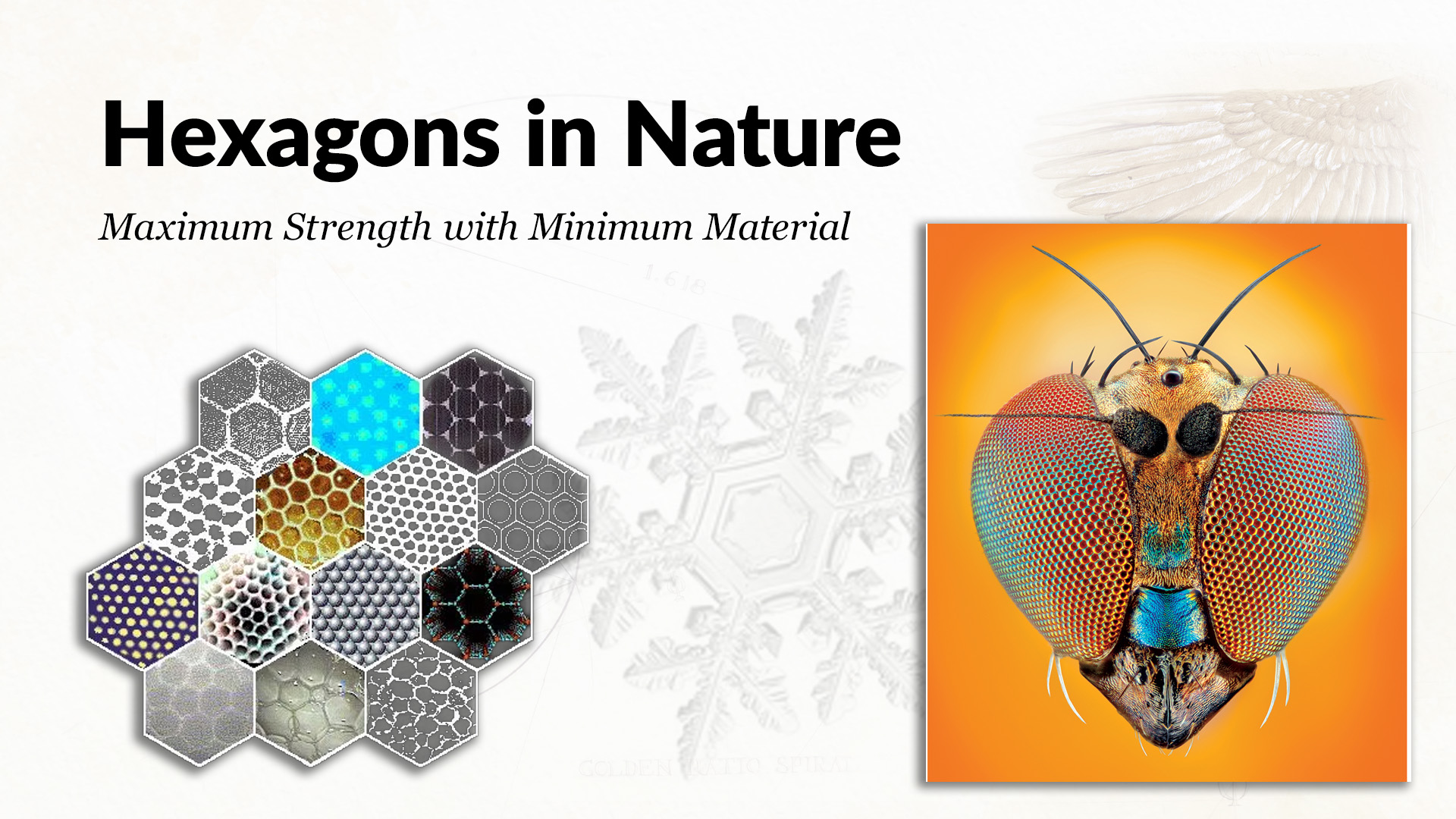
Hexagons are a naturally efficient shape found in beehives, turtle shells, and snowflakes. This six-sided pattern allows for maximum strength and minimal material use. Bees build hexagonal honeycombs to store honey and larvae while using the least amount of wax. Insect eyes, like those of dragonflies, have hexagonal lenses for wide-angle vision.
Some fish scales and snake skin form hexagonal patterns for flexibility and protection. Engineers mimic hexagonal designs in materials, architecture, and technology to create strong, lightweight, and efficient structures.
This is not an aesthetic preference. Of the three shapes that tile a flat plane without gaps — triangle, square and hexagon — the hexagon needs the least perimeter per unit of area enclosed. For a bee, perimeter is wax, and wax is expensive: a bee must eat roughly eight grams of honey to produce one gram of it.
Biomimicry Applications
- Aerospace Materials: Honeycomb sandwich panels are found throughout aeroplane components - from the fuselage and wings, to the ailerons and flaps.
- Architecture: The Beijing National Stadium (the "Bird’s Nest") incorporates hexagonal patterns. See more examples of hexagonal design in architecture here.
- Robotics: Soft robotic skins mimic hexagonal muscle fibers for flexibility, and even sensory abilities.
You can read more about why honeycombs are hexagons here.
4. Optimised Flow: Fluid Flow & Energy Efficiency
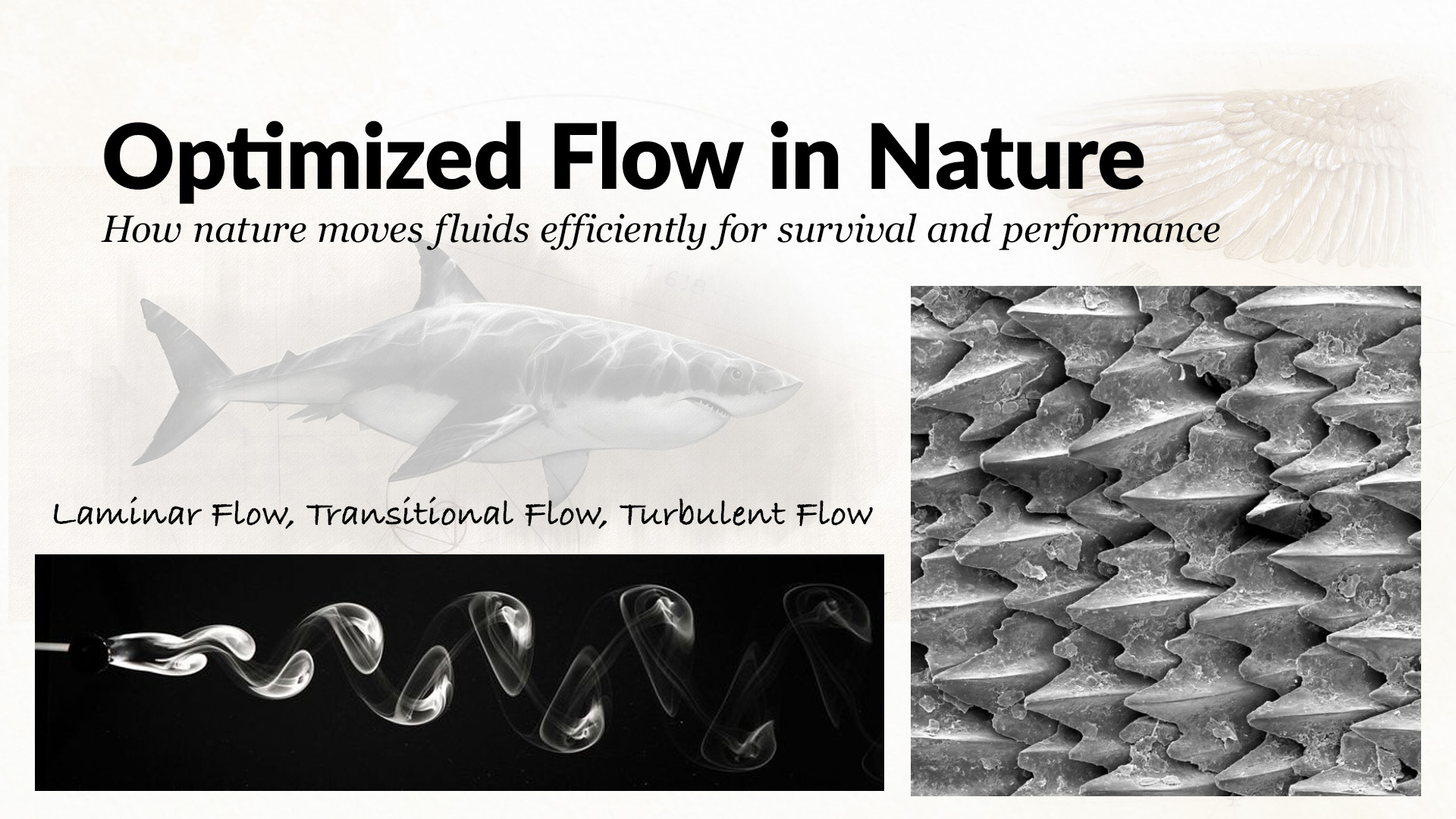
Fluid and aerodynamics in nature help organisms move efficiently through air and water. Birds and fish have streamlined bodies to reduce drag, allowing for faster, energy-efficient movement. Shark skin has tiny ridges that minimize water resistance, inspiring swimwear and ship coatings.
Leaves and insect wings use aerodynamic shapes to control airflow for stability and lift. Even seeds, like maple samaras, use aerodynamic principles to glide on the wind. Engineers apply these natural strategies to improve transportation, energy efficiency, and design.
Biomimicry Applications
- Swimsuits: The now-banned suits designed by Speedo & NASA were inspired by sharks. During the 2008 Olympics, the US swimming team won 98% of all Olympic gold medals.
- High-Speed Trains: The Shinkansen bullet train in Japan mimics the beak of a kingfisher's aerodynamics.
- Building Ventilation: Zimbabwe's Eastgate Centre, deemed an icon of sustainable design, mimics the natural ventilation in termite mounds to maintain near-constant temperatures all year long, using less than 10% of the energy of conventional means.
5. Branching Patterns in Nature: Optimal Distribution of Resources
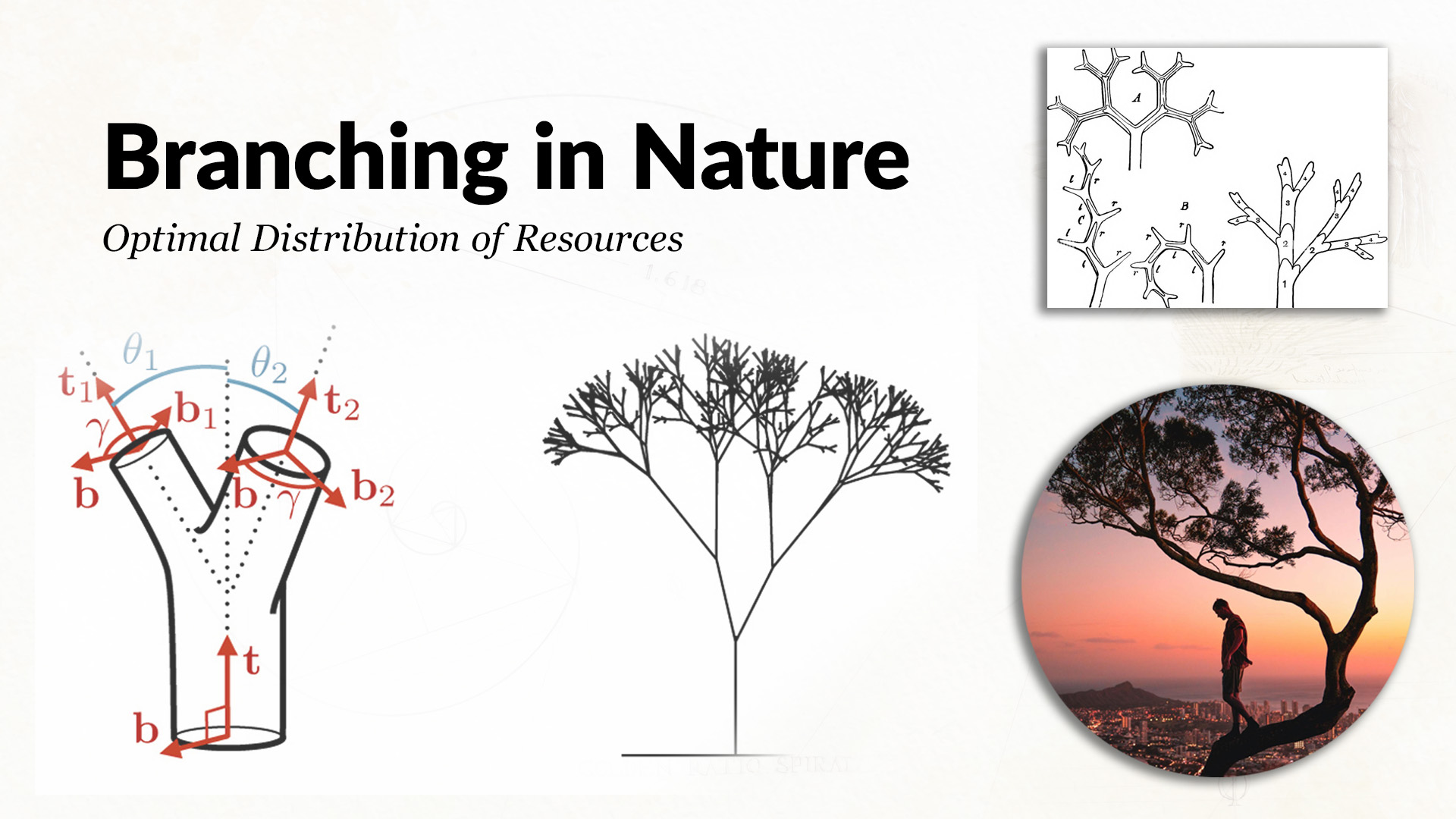
Branching is a common pattern in nature that maximizes efficiency in growth, transport, and resource distribution. Trees and plants use branching to spread leaves for optimal sunlight absorption. Blood vessels and lung bronchi branch to efficiently deliver oxygen and nutrients.
River systems and root networks use branching to distribute water and nutrients across large areas. Even neurons in the brain branch to enhance communication. Engineers and designers mimic branching structures to improve networks, fluid systems, and sustainable infrastructure designs.
Branching and fractals are close relatives — most branching systems in nature are fractal, repeating the same split at smaller and smaller scales. The difference is one of emphasis: fractals describe the geometry, branching describes the job it does.
Biomimicry Applications
- Transportation Networks: Many networks, such as some air traffic and road systems follow branching patterns.
- Built Environment: Strong by Form develops various wooden structural products and construction materials, inspired by the way trees grow.
- Water Management: Water transport systems that mimic gravitational flow like that found in tree roots, are highly efficient.
- Computer Coding: Mimicking branching patterns in coding is needed for programs to run correctly based on certain conditions determined by users.

Free eBook
A Field Guide to Biomimicry
10 years to build, 10 minutes to read. Gain the skills to apply biomimicry to your business, projects and daily life.
Get the free eBook →6. Tessellations: Efficient Tiling Without Wasting Space
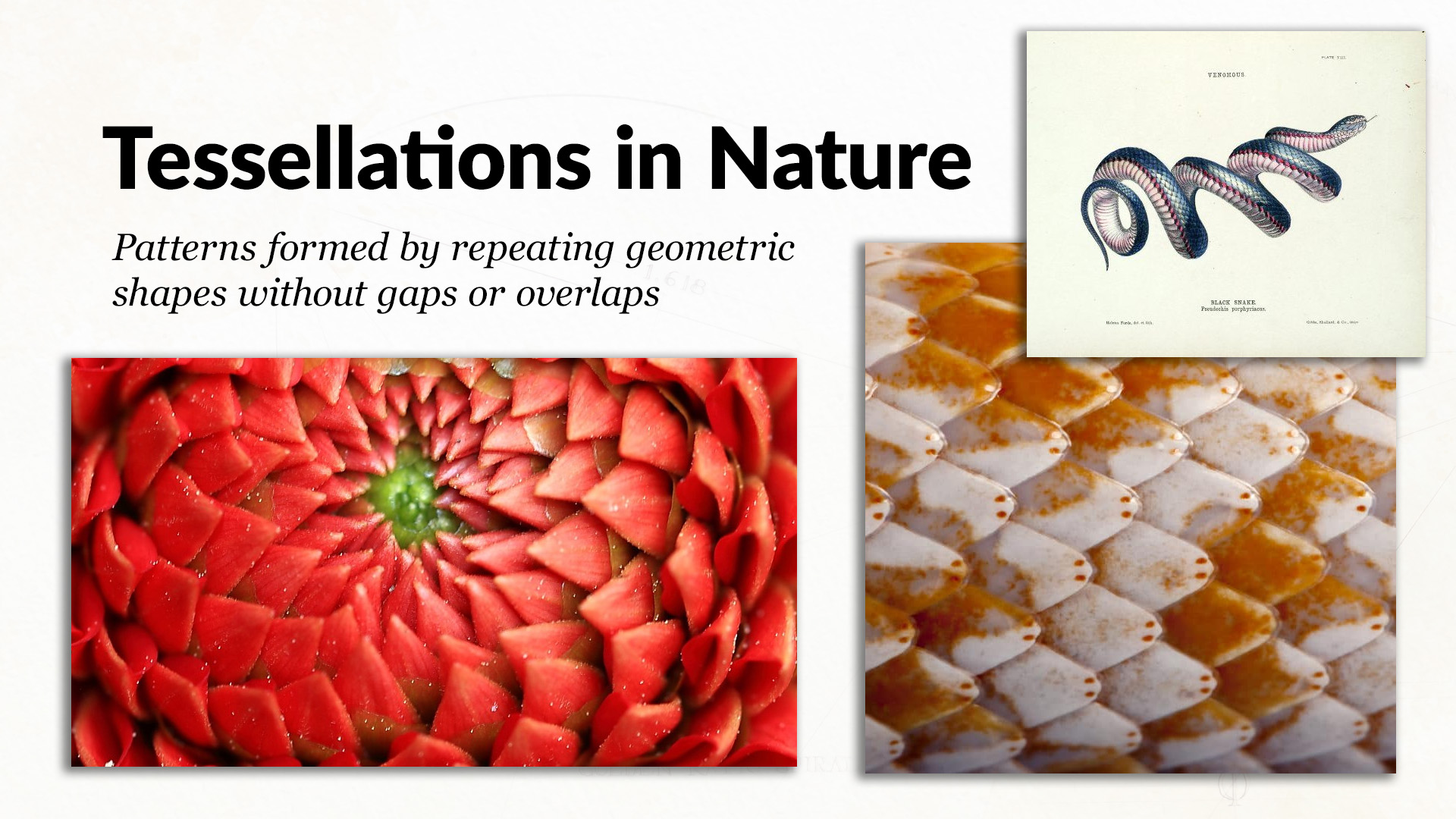
Tessellation in nature involves repeating geometric patterns that fit together without gaps, optimizing strength, efficiency, and space usage. Honeycomb structures in beehives use hexagonal tessellation to store honey with minimal wax. Snake scales and fish skin tessellate for flexibility and protection. Turtle shells and insect exoskeletons form interlocking plates for durability.
Even plant cells arrange in tessellated patterns for structural support. Engineers and architects apply natural tessellation to create strong, lightweight materials, efficient packaging, and innovative structural designs.
Nature's tessellations are rarely perfect. A turtle's scutes and a pineapple's scales vary in size and shape, but still meet edge to edge with no gaps — an irregular tessellation, which turns out to be more tolerant of growth and damage than a rigid one.
Biomimicry Applications
- Geodesic Domes: The Eden Project’s dome is based on tessellations.
- Functional Backpacks: Pangolin Backpacks have designed backpacks that mimic the structure of a pangolin's scales so that your laptop and other vitals can be protected extremely well.
- Built Environment: The laying of building materials such as tiles and bricks are also examples of tessellation.
7. Lattice Structures: Strength & Lightweight Design
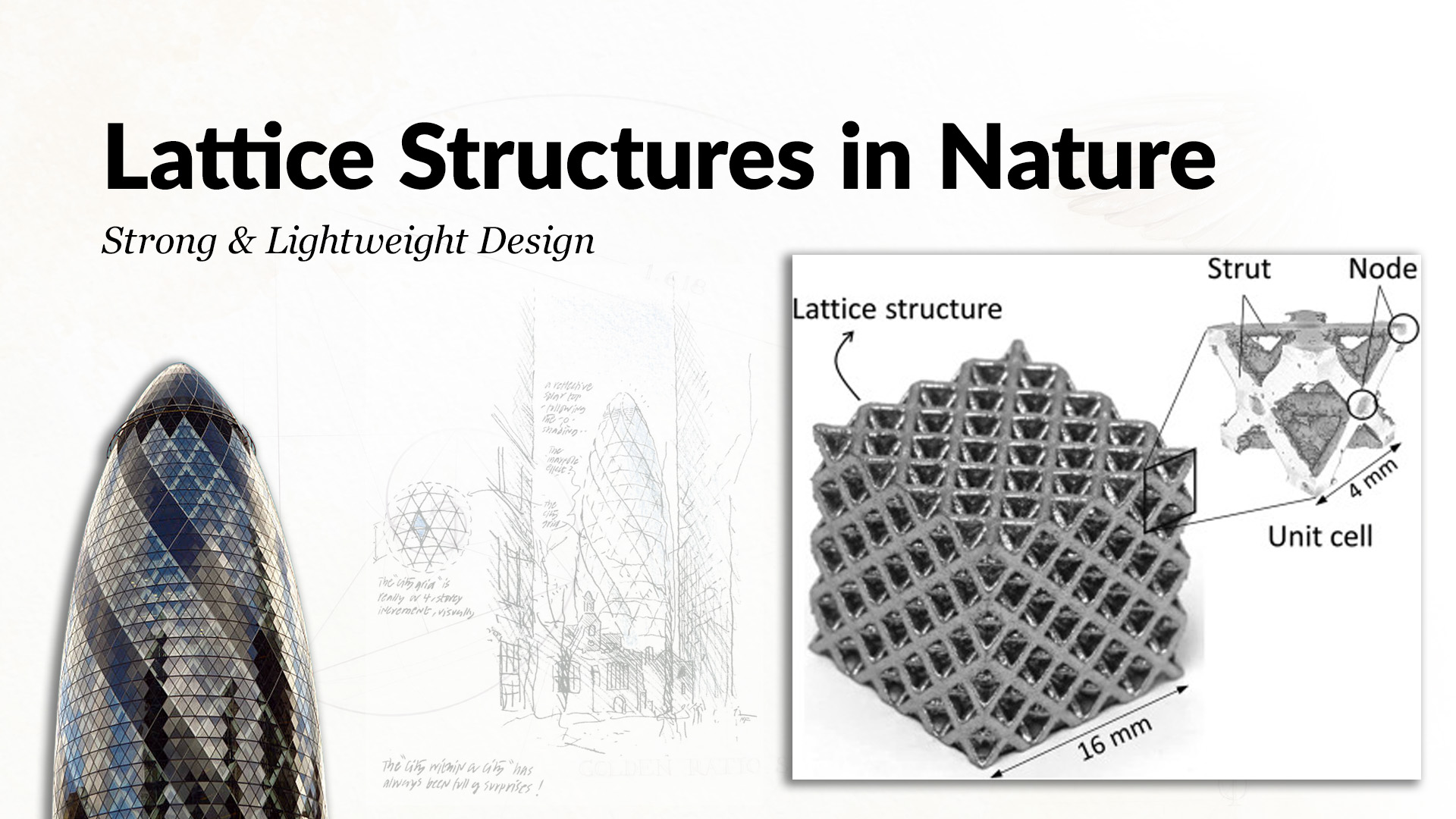
Lattice structures in nature provide strength, flexibility, and efficiency through repeating patterns of interconnected elements. Bird bones have lightweight lattice-like interiors for flight, balancing strength with reduced weight. Sponge skeletons and coral reefs use lattice frameworks for stability and efficient water flow.
Dragonfly wings have intricate lattice patterns that enhance durability while remaining light. Even crystalline structures in minerals and ice follow lattice arrangements. Engineers and designers mimic natural lattice structures in architecture, materials science, and biomedical implants for strength and efficiency.
Biomimicry Applications
- Aerospace & Automotive: Aircraft structures such as fuselage, wings, and mechanical parts are often used by organisations such as Boeing. Another example is the brake ducts used in many Formula 1 cars.
- 3D Printing: Many objects that are 3D printed use lattice structures, or additive manufacturing. Prosthetics is an example, and are strong yet lightweight.
- Sports Equipment: Modern running shoes have soles that incorporate lattice structures.
8. Dendritic Patterns: Growth & Flow Optimisation
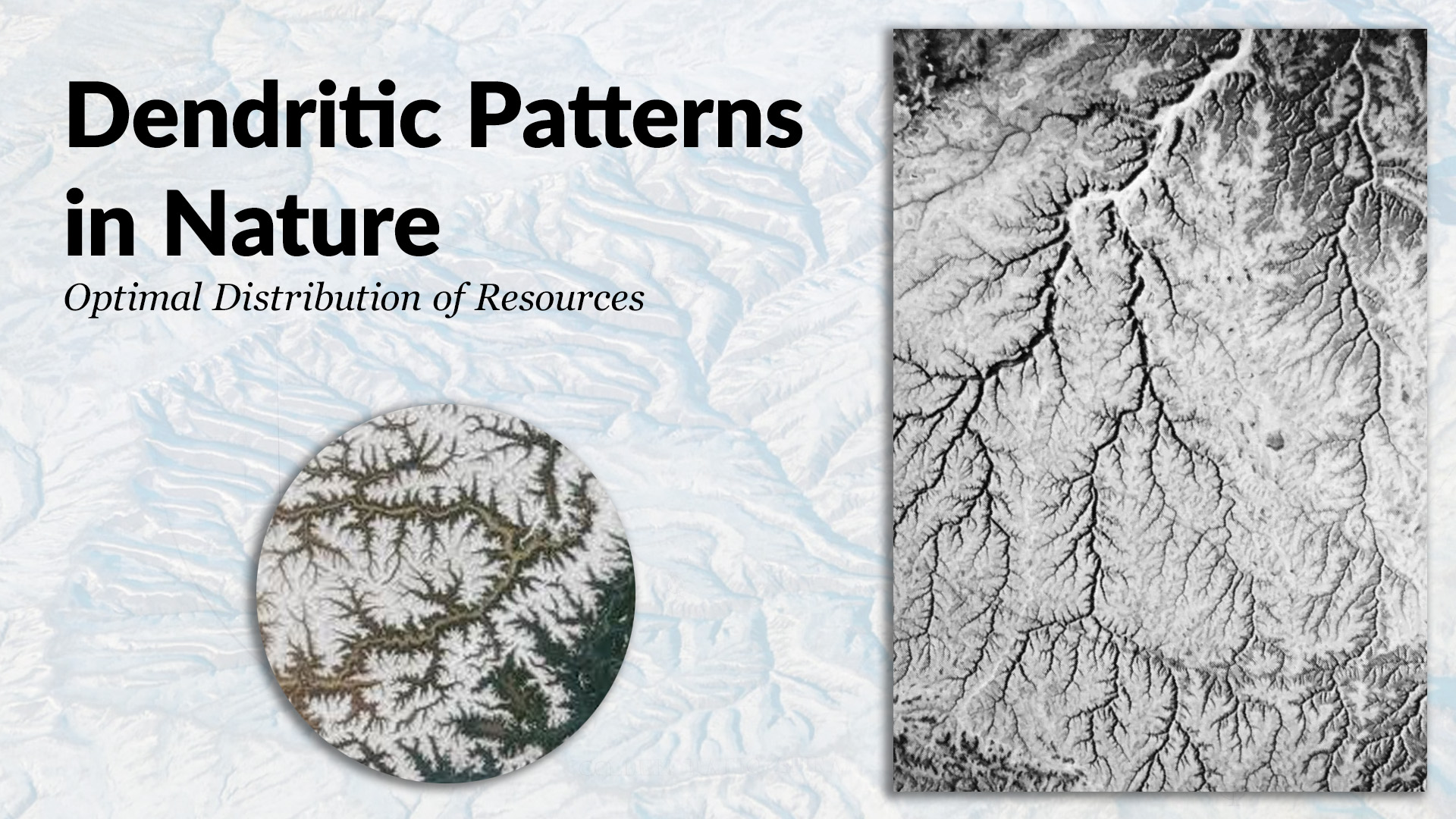
Dendritic patterns resemble the roots of trees and are found in nature for efficient transport and distribution. Blood vessels and nerve cells use dendritic structures to optimize oxygen flow and signal transmission. River networks and plant roots spread in dendritic patterns to distribute water and nutrients.
Snowflakes and frost form dendritic crystals due to molecular branching. Even coral growth follows dendritic structures for maximum surface area. Engineers apply dendritic designs in fluid systems, electronics, and city planning to improve efficiency and connectivity.
Biomimicry Applications
- Circuit Boards: Electronic circuits mimic dendritic flow for efficiency
- Water Filtration: Desalination plants optimize flow using dendritic patterns.
- AI & Neural Networks: Machine learning algorithms mimic brain dendrites.
9. Fibonacci Sequence: Mathematical Growth & Proportion
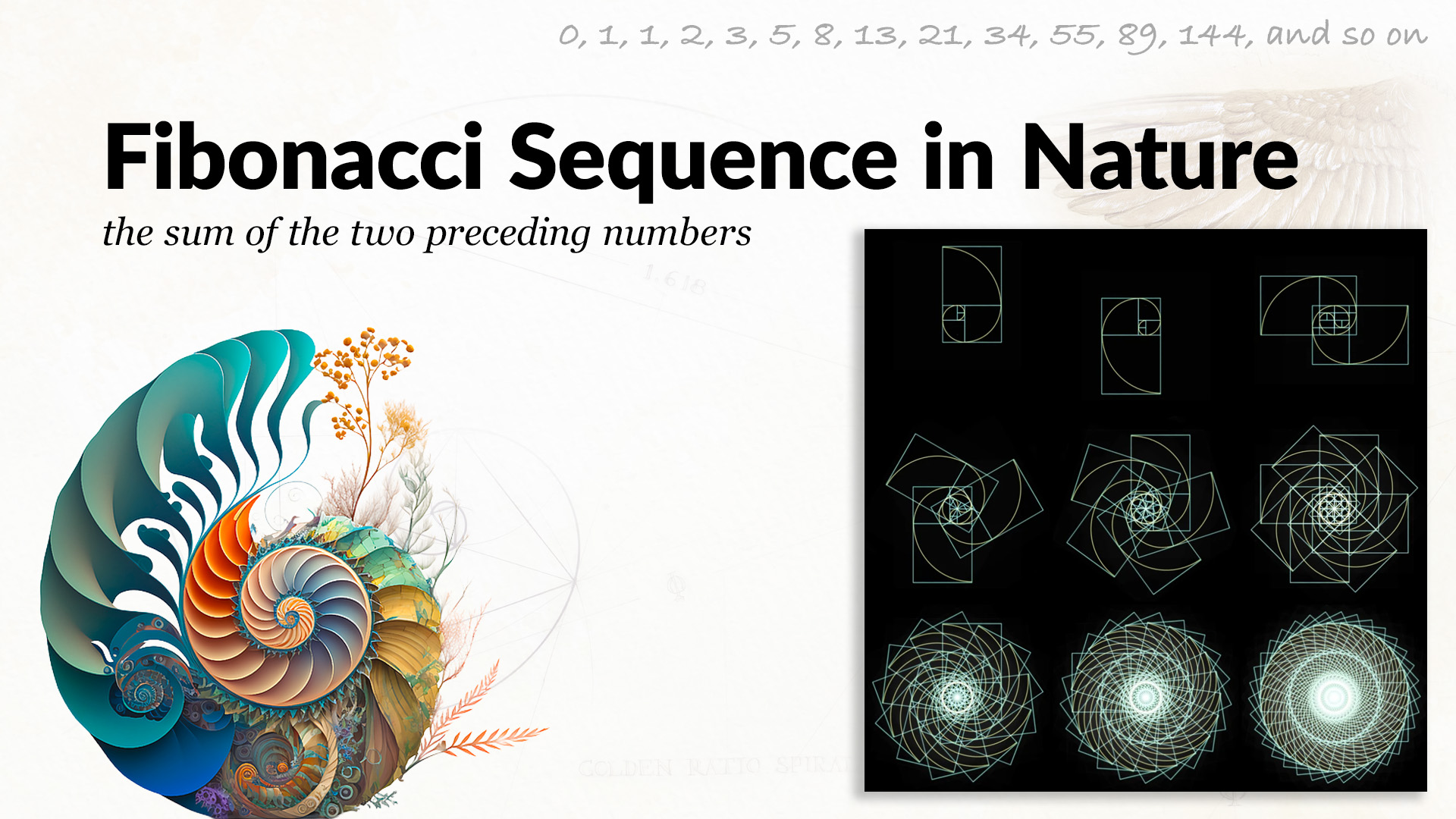
The Fibonacci Sequence, or Golden Ratio, is a mathematical pattern where each number is the sum of the two before it (1, 1, 2, 3, 5, 8…). It appears in nature to optimize growth, efficiency, and structure. Sunflowers and pinecones arrange seeds in Fibonacci spirals for space efficiency. Pineapples, succulents, and shells follow this sequence for balanced growth.
Even animal proportions, like rabbit populations and spiral horns, reflect Fibonacci patterns. Engineers and designers use these principles in architecture, robotics, and computer algorithms for efficiency.
A word of caution here, because this is the pattern most often overstated. Seed heads and phyllotaxis genuinely do follow Fibonacci numbers, and for a good reason: placing each new seed at roughly 137.5° from the last packs the head with no gaps and no repeating rows. Many other claims — the Parthenon, the human face, the nautilus shell — do not hold up when the proportions are actually measured. The real mathematics is more interesting than the myth.
Biomimicry Applications
- Wind and water turbines: Spiral geometry drawn from the Fibonacci sequence has been used to improve turbine efficiency — read how the Fibonacci sequence inspired turbine design.
- Architecture: Many famous buildings are believed to adhere to the Fibonacci sequence — though the evidence is thinner than usually claimed.
- Art & Music: When it comes to aesthetics, artists make use of the Golden Ratio in paintings. In music, Mozart's sonatas are known to incorporate this sequence (the number of bars of music in the latter section divided by the former is approximately 1.618, the Golden Ratio).
10. Camouflage: Colour matching, disruptive camouflage, mimesis
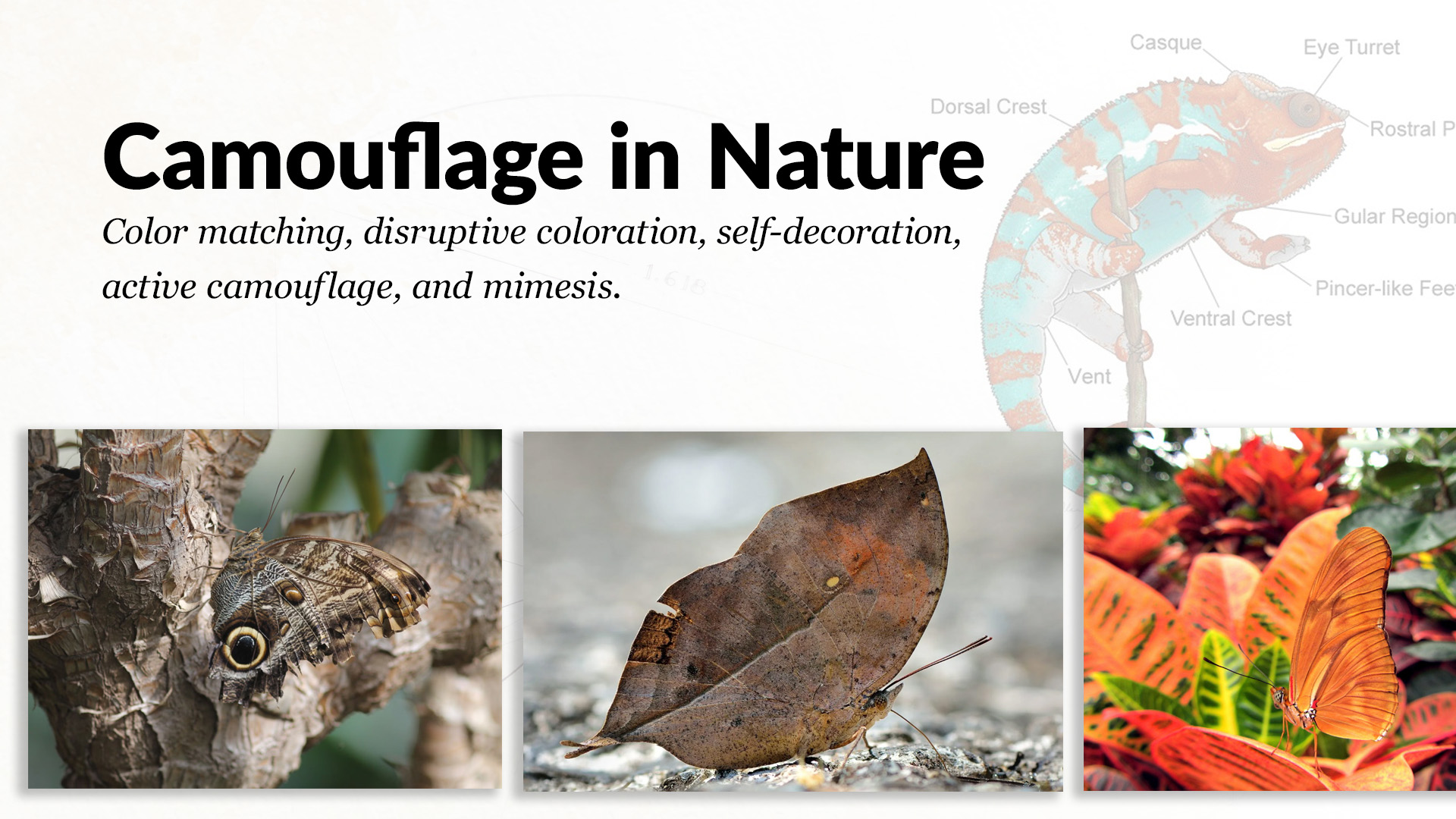
Camouflage is a method of concealment that allows an organism or object to blend into its surroundings, making it less visible to predators, prey, or observers. In nature, animals like chameleons and cuttlefish can change their skin color to match their environment, helping them avoid predators or sneak up on prey. Similarly, leaf insects and stick insects mimic the appearance of foliage and twigs to remain hidden in plain sight.
Biomimicry Applications
- Military & Fashion: Camouflage clothing is inspired by animal adaptations. This is especially used in military apparel and equipment to blend into a respective environment like forests, deserts, snowscapes, etc.
-
Automotive Industry: Dazzle Camouflage in Prototype Testing. Car manufacturers like BMW and Toyota use “dazzle” or high-contrast camouflage wraps on prototype vehicles during road tests. This disrupts the visual lines of the car, making it difficult to discern shape and design details before official release.
-
Architecture: Some architectural firms design buildings or structures that blend into the environment. For instance, BIG’s (Bjarke Ingels Group) “Camouflage House” uses mirrored facades to reflect the surrounding landscape, making the building almost invisible from certain angles.
11. Bonus! Functional Surfaces
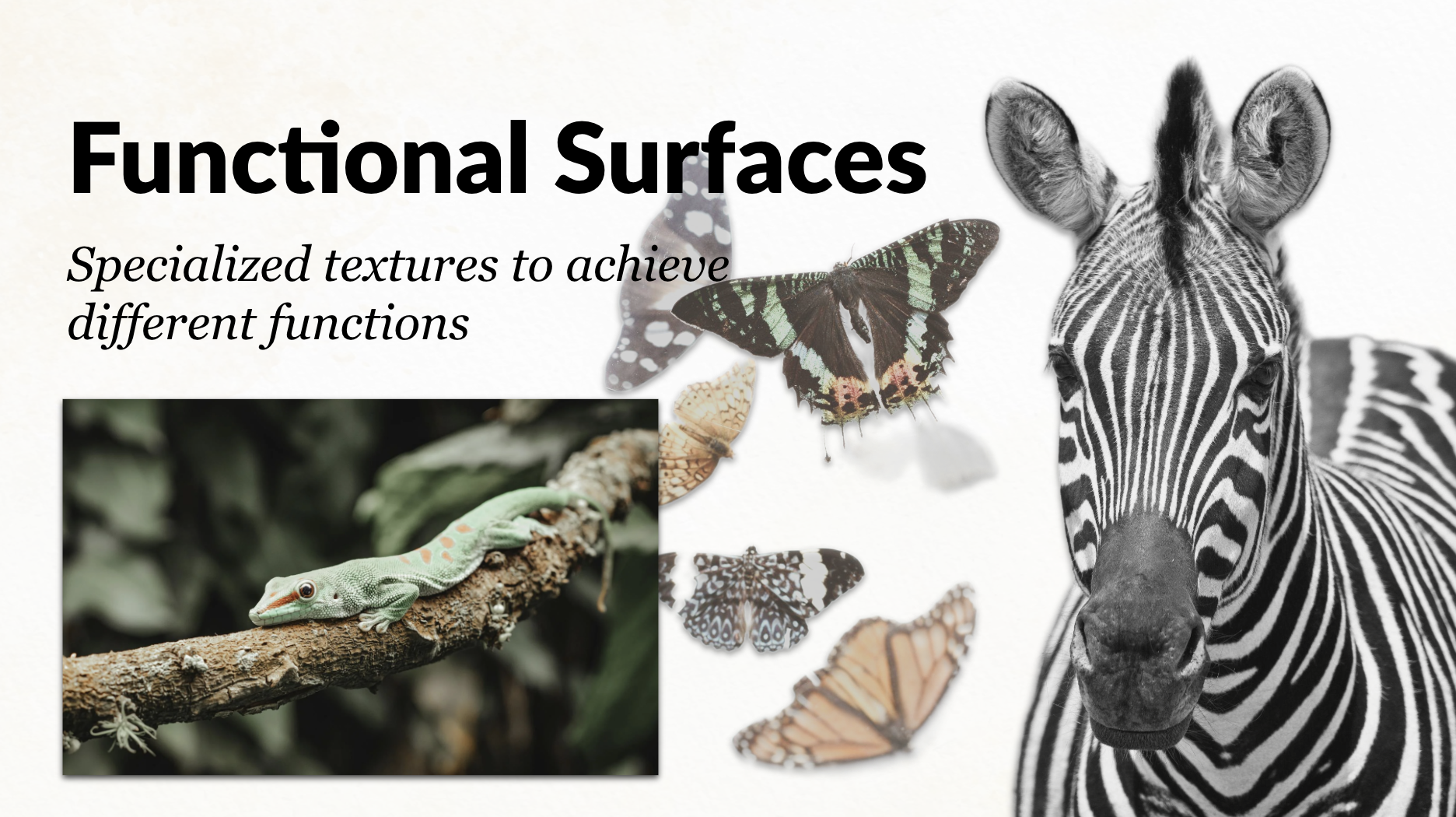
Functional surfaces in nature have specialized textures that enhance survival and efficiency. In zebras the black-and-white stripes can confuse predators during a hunt. Stripes also help zebras recognize each other, as each pattern is unique, aiding in social bonding within herds. Lotus leaves have microstructures that repel water, keeping them clean and dry. Gecko feet use microscopic hairs to grip surfaces, allowing them to climb walls.
Shark skin has tiny ridges that reduce drag, improving swimming efficiency. Butterfly wings use nanostructures to create vibrant colors without pigments. Engineers mimic these surfaces in self-cleaning materials, adhesives, and aerodynamic designs, applying nature’s solutions to technology, medicine, and sustainable innovations.
The colour trick in that last example has a name and a whole field behind it — read how structural colour works.
Biomimicry Applications
- Functional flooring: Interface creates nature-inspired flooring products and biophilic surfaces, designed to incorporate nature into built structures.
- Waterproof Textiles: Inspired by liquid-repellant surfaces like the lotus leaf, Amphico has developed recyclable and PFAS-free, waterproof apparel and gear for the outdoor and sportswear industry.
- Structural Colour in Fabric: Cypris Materials are using structural colour to replace harmful dyes, inspired by surfaces like peacock feathers.
Interested in getting practical? Read: How to Learn From Nature to explore the process of translating natural inspiration into design principles, step by step.
The mathematics behind nature's patterns
Every pattern above is the visible result of a mathematical rule being applied under physical constraint. You do not need the equations to use the patterns, but knowing which rule is at work tells you when a pattern will transfer to your design and when it will not.
Geometry in nature: why certain shapes keep winning
Geometry is everywhere in nature, and these patterns serve critical functions. Hexagons appear in honeycomb structures, offering the strongest tiling with the least material. Spirals emerge in nautilus shells and sunflower seed heads, packing space efficiently. Branching fractal geometry is seen in trees, rivers, and blood vessels, maximising distribution across networks. Tessellating scales on fish and reptiles provide flexible yet protective coverage.
What unites them is a constraint being minimised. Hexagons minimise perimeter. Spirals minimise the cost of growth. Branches minimise the distance a resource must travel. When you know which quantity nature was economising on, you know whether the same shape will help you.
Fractal dimension and self-similarity
Fractal patterns are self-similar structures that repeat at different scales. From the branching of fern leaves to the jagged edges of coastlines, fractal geometry appears throughout the natural world. Snowflakes, Romanesco broccoli, mountain ranges, and lightning bolts all exhibit fractal properties.
These patterns arise because they maximise surface area, optimise resource distribution, and allow organisms to grow efficiently within constrained spaces. Engineers have applied them to create stronger antenna designs, more efficient solar cells, and advanced filtration systems — proving that nature's mathematical elegance has real engineering value.
Phyllotaxis and the 137.5° angle
The arrangement of leaves and seeds around a stem — phyllotaxis — is where Fibonacci numbers genuinely earn their reputation. Place each new element at about 137.5° from the previous one and the result never lines up into rows, which means no element sits directly above and shades another. That angle is the golden angle, and it is the only one that achieves this. Count the spirals in a sunflower head and you will find consecutive Fibonacci numbers, usually 34 and 55, or 55 and 89.
Voronoi cells and packing
When a set of points each claim the territory nearest to them, the result is a Voronoi diagram — and nature builds them constantly. Dragonfly wings, giraffe coats, soap foam, cracked mud and the cells of a leaf are all approximate Voronoi patterns. They form because growth spreads outward from many points at once until the fronts meet. Designers use the same construction for lightweight structural panels, because it distributes material where load needs carrying and leaves gaps where it does not.
Turing patterns: how stripes and spots form
In 1952 Alan Turing showed that two interacting chemicals, one activating and one inhibiting, can spontaneously produce stripes, spots and labyrinths from a uniform starting state. Zebra stripes, leopard rosettes, the ridges on your fingertips and the markings on tropical fish are all thought to arise this way. It is a rare case of a biological pattern being predicted mathematically decades before the biology was understood.
How designers use these patterns
Recognising a pattern is the easy half. The useful half is knowing what function it performed in its original context, and whether your design problem shares that function.
A honeycomb is not simply a nice shape to put on a facade. It is a solution to the problem of enclosing volume with minimum material under compression. If your problem is compression and material cost, the pattern transfers. If your problem is tension or thermal performance, it may not.
That translation step — from biological strategy to design principle to applied solution — is the discipline of biomimicry, and it is what separates nature-inspired decoration from nature-inspired engineering.
Want to apply this properly? The Biomimicry Practitioner Programme takes you from recognising patterns to running your own biomimicry project, over six mentored months.
Frequently asked questions about patterns in nature
How many patterns are there in nature?
There is no fixed number, because it depends on how finely you divide them. Most classifications land somewhere between five and fifteen. This article uses ten, plus functional surfaces as a bonus, because these are the ones that recur most often and transfer most usefully into design. A stricter list might collapse branching and dendritic patterns into fractals, giving eight. A looser one might separate waves, cracks and foams out on their own, giving fifteen.
What are the 5 patterns in nature?
The five most commonly cited are spirals, fractals, hexagons or tessellations, branching, and waves. If you only learn five, learn these — between them they account for the majority of repeating forms you will encounter, and each one solves a distinct class of problem: growth, distribution, tiling, transport and energy transfer.
Why do patterns repeat in nature?
Because the same physical problems recur, and physics does not offer many efficient answers to each one. A river and a lung both need to move a flow across an area; branching is the least costly way to do it, so both branch. This is convergent evolution in geometric form — unrelated systems arriving at the same shape because the shape is the solution.
What is the most common pattern in nature?
Branching, by most counts. It appears in plants, rivers, lightning, blood vessels, lung tissue, neurons, root systems, coral and mineral crystals. Spirals are a close second. The hexagon is the most famous but is actually less widespread than either — it needs quite specific conditions of equal pressure from all sides to form.
What is a natural pattern, and how is it different from a designed one?
A natural pattern emerges from process and constraint rather than intention. Nobody decided a snowflake should have six arms; the geometry of the water molecule made it so. A designed pattern is chosen, usually for how it looks. The distinction matters in biomimicry, because when you copy a natural pattern you are copying the outcome of a process — and the pattern will only work for you if your constraints resemble the original ones.
What are mathematical patterns in nature?
Mathematical patterns in nature are repeating forms that follow a describable rule: Fibonacci sequences in seed heads, logarithmic spirals in shells, fractal dimensions in coastlines, Voronoi tessellation in dragonfly wings, and Turing patterns in animal markings. Each has an equation behind it, and each equation describes a quantity being minimised or maximised under constraint.
In Summary
Biomimicry is revolutionizing design, engineering, and sustainability. By learning from nature’s genius, we can build more efficient, resilient, and beautiful solutions. Whether it’s optimizing energy use, improving materials, or enhancing technology, these natural patterns offer endless inspiration.
Wild regards
Alistair
PS - I've been studying the best biomimicry examples since we started Learn Biomimicry. The patterns are emerging, and you'll find it within the Biomimicry Short Courses we created. 1,689+ learners have joined us from 41+ countries. I hope you'll join the biomimicry movement too.
PPS - if you're interested in learning more about biomimicry, you can download this free eBook: A Field Guide to Biomimicry.

Biomimicry Short Course Set
Design with patterns, not just admire them
Three self-paced courses, one price: $198. Learn to apply nature's patterns and strategies in your own work, with a certificate for each course.
See the short courses →
Free eBook
A Field Guide to Biomimicry
10 years to build, 10 minutes to read. Gain the skills to apply biomimicry to your business, projects and daily life.
Get the free eBook →
Here’s the one biomimicry course you need that turns these examples and insights into a skill set. Trusted by 1,679+ Learners. Three self-paced courses, one price. $198 US.
10 years to build, 10 minutes to read. This eBook is the essence of biomimicry.
Recent Posts