
Tessellations in Nature: 12 Examples and the Geometry Behind Them
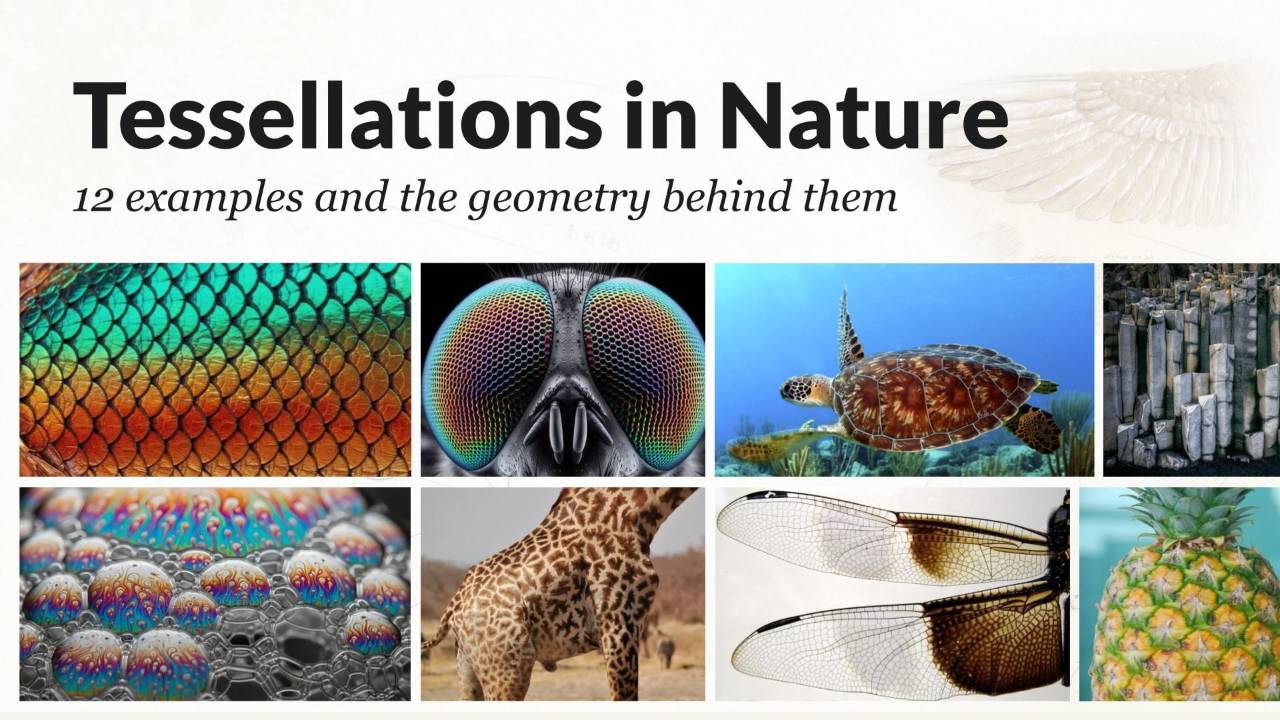
A tessellation in nature is a repeating arrangement of shapes that covers a surface with no gaps and no overlaps. Honeycomb, turtle shells, basalt columns and dragonfly wings are all tessellations, and each one exists because tiling a surface completely is the cheapest way to do a particular job.
Nature tessellates when it needs to cover something — a body, a surface, a volume — using the least material, or when a growing structure has to share space with its neighbours and nobody can afford a gap.
This article covers what a tessellation actually is, the geometry that makes some tilings better than others, twelve examples from nature with the function each one performs, and how designers have borrowed them.
Ready to start learning biomimicry? You can download this free eBook: A Field Guide to Biomimicry. It will help you understand the basics in a single read-through.
What is a tessellation?
A tessellation is a covering of a plane by one or more shapes, repeated, with no gaps between them and no overlaps. The word comes from tessella, the small cube of stone used in Roman mosaics.
Two conditions have to hold. The shapes must meet edge to edge, and together they must account for every point on the surface. A pattern with gaps is not a tessellation. Neither is one where the shapes sit on top of each other — which, as we will see, disqualifies a few of the examples people usually reach for first.
In mathematics tessellations are usually drawn as perfect, endlessly repeating grids. In nature they are almost never perfect. Cells vary in size, edges bend, and the pattern adapts around damage and growth. That irregularity is not a failure of the pattern — it is usually what makes it survivable.
The three regular tessellations — and why hexagons win
Only three regular polygons tile a flat plane on their own: the equilateral triangle, the square, and the hexagon. Every other regular shape either leaves gaps or has to overlap. Pentagons, famously, cannot do it.
So nature has three options, and it overwhelmingly picks the hexagon. The reason is perimeter.
For a given area enclosed, the hexagon needs less perimeter than the square, which needs less than the triangle. If perimeter costs you something — wax, protein, surface tension, energy — the hexagon is the cheapest way to divide up a surface. This is the honeycomb conjecture, proposed by the Roman writer Varro in 36 BC and not actually proved until the mathematician Thomas Hales did it in 1999.
There is a second reason, and it matters just as much. When three edges meet at a point, the most stable arrangement is three angles of 120° each — which is exactly the interior angle of a hexagon. Any junction of three surfaces under equal tension will relax toward 120°. This is why soap foam, cooling basalt and drying mud all end up hexagonal without any biology involved at all.
The honeycomb case in full: why honeycombs are hexagons, and the corner-radius discovery that changed how engineers build them.
12 tessellations in nature
1. Honeycomb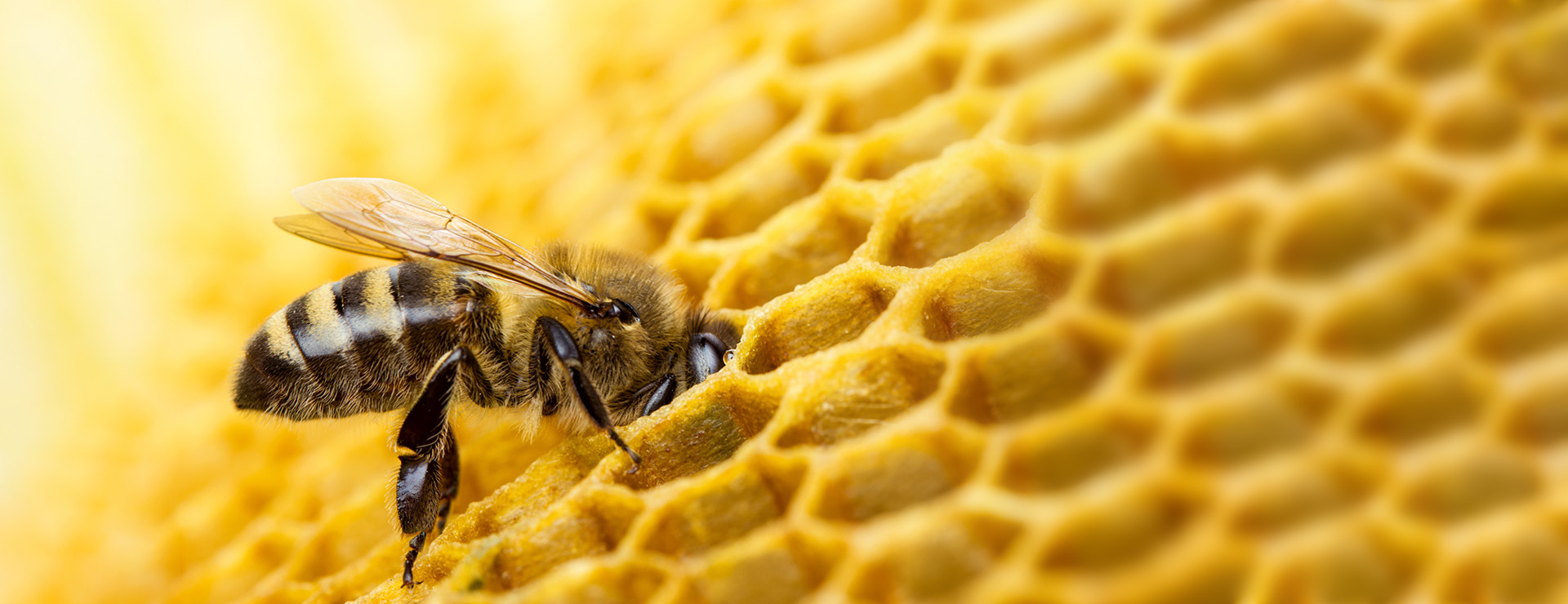
The canonical example. Bees build hexagonal cells in wax to store honey and raise brood. Wax is metabolically expensive — a worker bee must consume roughly eight grams of honey to secrete one gram of it — so the hexagon's perimeter economy translates directly into food saved. The cells are also built at a slight upward tilt, so honey does not run out.
2. Turtle and tortoise shells
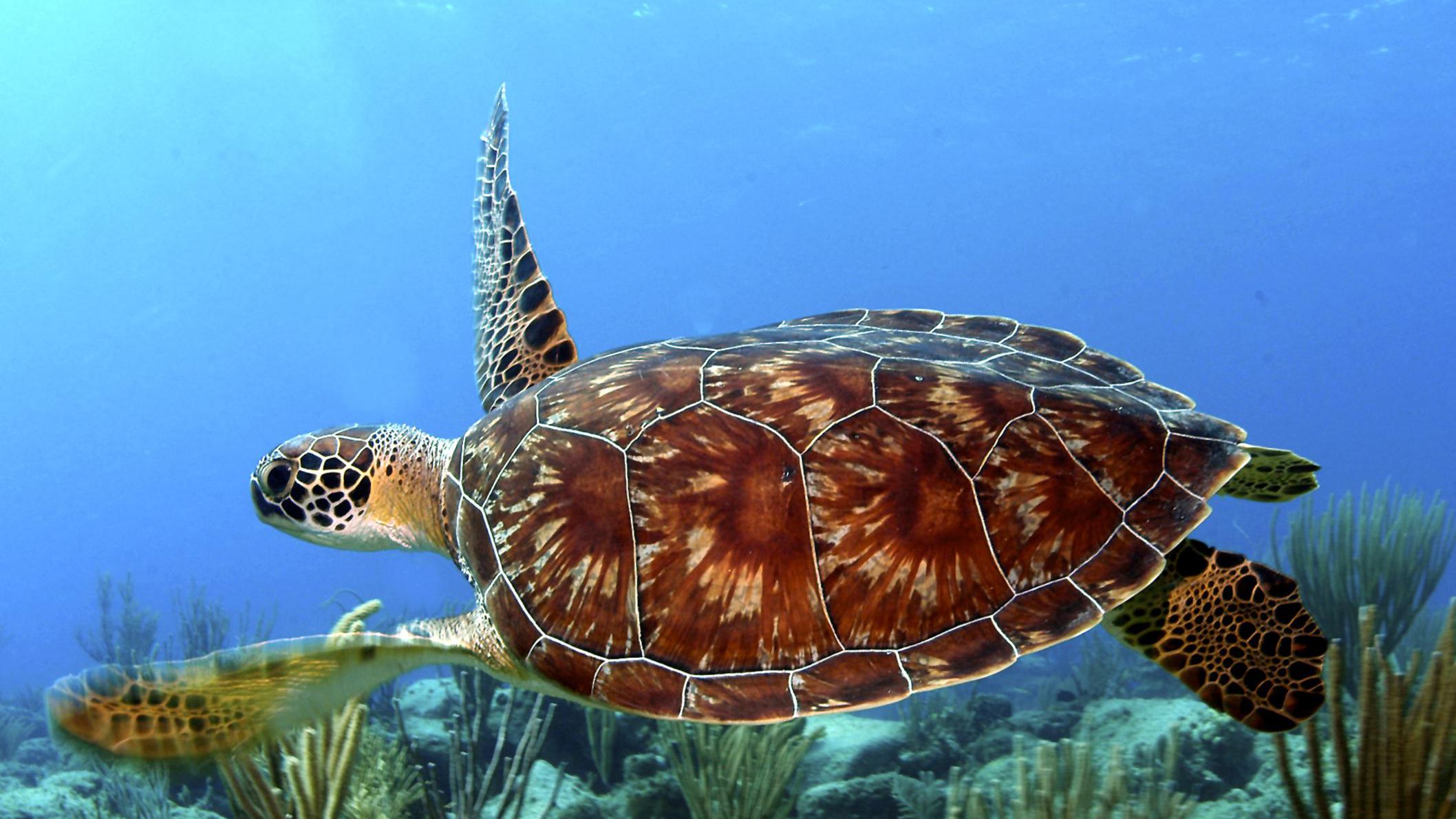
The scutes covering a turtle's carapace are keratin plates that meet edge to edge across the whole shell. They are irregular polygons rather than uniform hexagons, because they have to grow with the animal and wrap a curved surface. The tessellation spreads an impact across several plates instead of concentrating it in one.
3. Pineapple

What looks like a single fruit is a fused cluster of individual fruitlets, each one a hexagonal-ish tile. They are arranged in intersecting spirals, and the number of spirals in each direction is almost always a pair of consecutive Fibonacci numbers. The tessellation is what lets dozens of fruitlets share one surface with no wasted space between them.
4. Corn kernels
Kernels on a cob pack into offset rows, each one flattened against its neighbours. Start with round seeds growing outward from a cylinder and let them press together until they run out of room, and this is the shape you get — the same packing logic as soap bubbles, worked in starch.
5. Basalt columns

The Giant's Causeway in Northern Ireland has around 40,000 interlocking columns, most of them hexagonal in cross-section. No organism made them. As a thick lava flow cools it contracts, and the contraction cracks propagate down from the surface, meeting at 120° because that is the arrangement that releases the most stress for the least new crack surface. Geology arriving at the bee's answer independently.
6. Dragonfly wings

A dragonfly wing is a membrane braced by a network of veins that divides it into thousands of irregular polygonal cells. The arrangement is close to a Voronoi diagram — the pattern you get when many points each claim the territory nearest to them. The cells vary in size across the wing, larger where the membrane needs flexibility and smaller near the leading edge where it needs stiffness.
7. Insect compound eyes
Each facet of a compound eye is an ommatidium, a self-contained optical unit with its own lens. Packing them hexagonally means no gap between facets and therefore no blind spot in the visual field. A dragonfly has around 30,000 of them.
8. Soap foam

Not biological, but it demonstrates the physics cleanly. Bubbles pressed together flatten into polyhedra whose walls meet in threes at 120°, following what are known as Plateau's laws. Foam is the purest demonstration that a tessellation can emerge from surface tension alone, with no template and no plan.
9. Cracked mud

A drying mudflat cracks into polygons. Where drying is slow and even, the cracks meet at roughly 120° and the polygons approach hexagons. Where it is fast or uneven, cracks meet at right angles and the shapes become rectangular. You can read the drying history off the geometry.
10. Giraffe coat
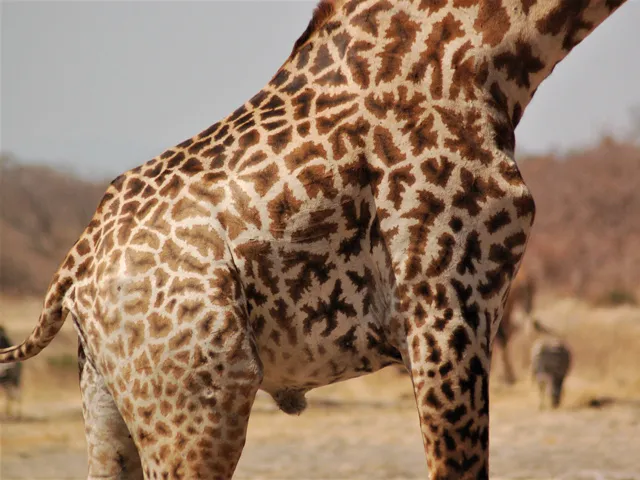
The patches on a giraffe are polygonal and meet along narrow pale channels, forming an irregular tessellation across the whole body. The pattern is thought to form through a reaction-diffusion process during development, and the channels between patches carry blood vessels that help shed heat.
11. Fish scales

Here is where the definition gets interesting. Fish scales overlap — they are imbricate, like roof tiles — which means strictly speaking they are not a true tessellation at all. What they demonstrate is a trade: nature gives up the perfect edge-to-edge fit in exchange for flexibility and a double thickness of armour at every seam.
12. Snake skin
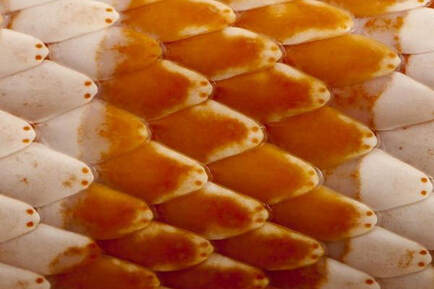

Same story, more so. A snake's scales overlap heavily so the skin can stretch enormously when the animal feeds, then contract again. The underlying skin between the scales is a true tessellation of cells; the visible scales are not. It is a useful reminder that the tessellation is often one layer down from the thing you can see.

Free eBook
A Field Guide to Biomimicry
10 years to build, 10 minutes to read. Gain the skills to apply biomimicry to your business, projects and daily life.
Get the free eBook →Tessellation, tiling or mosaic — what's the difference?
These three words get used interchangeably and they should not be.
A tessellation is the mathematical case: shapes meeting edge to edge, covering the plane, no gaps, no overlaps. A tiling is usually treated as a synonym, though it more often implies something deliberately made.
A mosaic is different. Mosaics have grout — visible gaps between the pieces — which means most mosaics are not tessellations. The distinction matters in design: if you are copying a natural tessellation for structural reasons, the gaps are exactly what you cannot afford.
And a pattern is the broadest term of all. All tessellations are patterns; most patterns are not tessellations.
How designers use tessellation
The function a natural tessellation performs determines whether it will transfer to your design. Three functions come up most often.
Material economy. Honeycomb sandwich panels put a hexagonal core between two thin face sheets, giving very high stiffness for very little weight. They are in aircraft floors, spacecraft, wind turbine blades and racing car bodywork. The bee's perimeter argument applies unchanged.
Coverage without waste. Solar panel layouts, packaging design and facade cladding all face the problem of covering an area with repeating units and no offcuts. Tessellation is the direct answer, and hexagonal packing beats rectangular for round cells.
Distributed protection. The turtle's insight — many plates rather than one shell — shows up in body armour, protective cases and impact barriers, where the goal is to spread a load across several units so no single one has to absorb it.
More on the crossover from biology to engineering: the top 50 biomimicry examples and inventions.
Frequently asked questions
Is a honeycomb a tessellation?
Yes. A honeycomb is the most cited tessellation in nature and a near-perfect one: the hexagonal cells meet edge to edge across the whole comb with no gaps. It is also a regular tessellation, because it uses a single regular polygon repeated. Worth noting that real comb cells have slightly rounded internal corners rather than perfectly sharp ones, which turns out to make them stronger.
What is the most common tessellation in nature?
The hexagon, by a wide margin. It appears in honeycomb, compound eyes, basalt columns, foam and dried mud. The reason is the 120° junction: whenever three boundaries meet under roughly equal pressure, they settle at 120°, and a surface divided that way is hexagonal.
Are tessellations always hexagons?
No. Only three regular polygons tessellate — triangles, squares and hexagons — and nature uses all three, along with a great many irregular polygons. Turtle scutes, dragonfly wing cells and giraffe patches are all irregular tessellations. The hexagon dominates because of perimeter economy, not because it is the only option.
What is an example of a tessellation pattern in nature?
Honeycomb is the clearest one: hexagonal wax cells tiling a surface with no gaps, built that way because hexagons enclose the most area for the least perimeter, and wax is expensive for a bee to make. Basalt columns, pineapple skin, turtle shells and insect compound eyes are equally good examples of the same principle at different scales.
Why does nature use tessellation?
For three reasons, usually together: it covers a surface without wasting material, it lets neighbouring structures grow into a shared space without leaving gaps, and it distributes stress across many units rather than concentrating it in one. Where all three matter at once — as in a beehive — the tessellation is close to perfect.
In summary
Tessellation is nature solving a coverage problem. When a surface has to be covered completely and material is scarce, the pattern that emerges is a tiling — and more often than not, a hexagonal one, because 120° is where three boundaries come to rest.
The useful question for a designer is never “what shape is it?” but “what was it paying for?” A bee is paying for wax. A cooling lava flow is paying for crack surface. If your design is paying for the same thing, the pattern will transfer.
This is one of ten patterns that recur across nature. Read the full set: Patterns in Nature: The 10 Types and What Each One Solves.
Wild regards
Alistair
PS - if you want to learn how to translate patterns like these into real design work, that is exactly what the Biomimicry Short Courses were built for.
Online Short Courses
Start your biomimicry journey
The depth of a degree, the ease of a TED talk. 10 years to build, 10 hours to complete.
Explore the short courses →
Here’s the one biomimicry course you need that turns these examples and insights into a skill set. Trusted by 1,679+ Learners. Three self-paced courses, one price. $198 US.
10 years to build, 10 minutes to read. This eBook is the essence of biomimicry.
Recent Posts