
What (Really) is Biophilic Design?

Biophilic design is the practice of connecting people to nature through architecture and interior design. This guide covers the core principles, proven benefits, real-world examples, and how it differs from biomimicry.
What is Biophilic Design?
A Complete Guide with Principles & Examples (2026)
Table of Contents
- What is Biophilic Design?
- The Core Principles of Biophilic Design
- Benefits of Biophilic Design
- Biophilic Design Examples in Architecture & Workplaces
- Biophilic Design vs Biomimicry: What's the Difference?
- How to Apply Biophilic Design
- How to Learn Biophilic Design Professionally
- FAQs
Too long, didn't read
Biophilic design integrates nature into the built environment - through natural light, living plants, organic materials, water features, and nature-inspired patterns - to improve human health, wellbeing, and productivity.
It draws on our innate connection to the natural world (biophilia) and applies it to spaces where people live, work, and learn. Research consistently shows it reduces stress, improves cognitive function, and boosts creativity. It differs from biomimicry: biophilic design brings nature into spaces, while biomimicry draws on nature's strategies to solve design problems.
What is Biophilic Design?
Biophilic design is an approach to architecture and interior design that reconnects people to nature within built spaces. The term comes from "biophilia" — the hypothesis, popularised by biologist E.O. Wilson, that humans have an innate, evolutionary affinity for the natural world.
The idea is simple: humans evolved in nature over millions of years. When we spend 80–90% of our time indoors — cut off from daylight, living plants, natural textures, and fresh air — our health and performance suffer. Biophilic design reverses that disconnection.
In practice, biophilic design encompasses far more than placing a potted plant on a desk. At its most sophisticated, it transforms entire spaces into cohesive, nature-rich environments: living green walls, abundant natural daylight, water features, organic material palettes, fractalized patterns, and views of the natural world — all working together to support human wellbeing.
By 2026, biophilic design has moved from niche architectural trend to a core pillar of how leading architects, workplace designers, and urban planners approach new projects. Wellness is now central to how we judge built spaces — and biophilic design is one of the most evidence-backed responses to that demand. Source: Design Middle East
The Core Principles of Biophilic Design
Most practitioners work from Stephen Kellert's foundational framework, which organises biophilic design into three categories:
1. Nature in the Space
Direct, physical presence of nature within a built environment:
- **Living plants and green walls** — from potted plants to full vertical gardens
- **Water features** — flowing water, reflecting pools, aquariums
- **Natural light** — skylights, light wells, daylight-optimising window placement
- **Natural air and breezes** — natural ventilation strategies
- **Animals and ecosystems** — views of wildlife, biodiversity-friendly outdoor spaces
2. Natural Analogues
Organic, nature-inspired elements that reference nature without being nature itself:
- **Natural materials** — timber, stone, bamboo, cork, rattan
- **Organic shapes and forms** — curves and irregular geometries that mirror natural forms
- **Fractals and natural patterns** — repeating patterns found in leaves, shells, and coastlines
- **Artwork and imagery** — photography, murals, and textures drawn from the natural world
- **Natural colour palettes** — earth tones, forest greens, ocean blues
3. Nature of the Space
Spatial experiences that evoke how humans feel in natural environments:
- **Prospect and refuge — the ability to see widely (prospect) while feeling sheltered (refuge), mirroring how our ancestors scanned landscapes
- **Mystery — partial concealment that draws the eye forward and invites exploration
- **Risk/peril** — safe exposure to heights, edges, and depth — like a glass floor over a long drop
- **Transitional spaces** — thresholds that blur the boundary between inside and outside
Benefits of Biophilic Design
The evidence base for biophilic design is robust and growing. Here is what the research shows:
Mental Health and Stress Reduction
A 2025 study published in Scientific Reports found that biophilic interventions — both in real and virtual environments — significantly reduced stress during cognitively demanding tasks. Source: PubMed Central
Natural elements in a space lower cortisol (the stress hormone), reduce heart rate, and activate the parasympathetic nervous system. Even a view of greenery through a window has measurable calming effects.
Productivity and Cognitive Performance
Research published in *Scientific Reports* on biophilic workplace design found that exposure to indoor nature increases employee vigour and job wellbeing — particularly for people with a strong affinity for nature. The study tracked longitudinal data across two cohorts of white-collar workers (n=345 and n=291). Source: Nature.com
Other studies estimate productivity gains of 8–15% in biophilically-designed workplaces, alongside reductions in absenteeism and improved staff retention.
Healthcare Settings
A 2024 systematic review in *Frontiers in Built Environment* analysed the impact of biophilic design on healthcare facilities and found significant improvements in patient recovery times, reduced pain medication use, and lower anxiety levels in both patients and care providers. [Source: Frontiers](https://www.frontiersin.org/journals/built-environment/articles/10.3389/fbuil.2024.1467692/full)
Education and Learning
Biophilic classrooms — those with natural light, plants, and organic materials — show measurable improvements in student attention, test scores, and overall wellbeing. Natural daylight alone has been linked to 20–26% higher test scores in some studies.
Biophilic Design Examples
1. The Jewel at Changi Airport, Singapore

This airport in Singapore boasts the largest indoor, human-made waterfall on earth, and a massive forest threaded through the terminals, restaurants and shops. There are multiple different gardens with walkways and viewpoints.
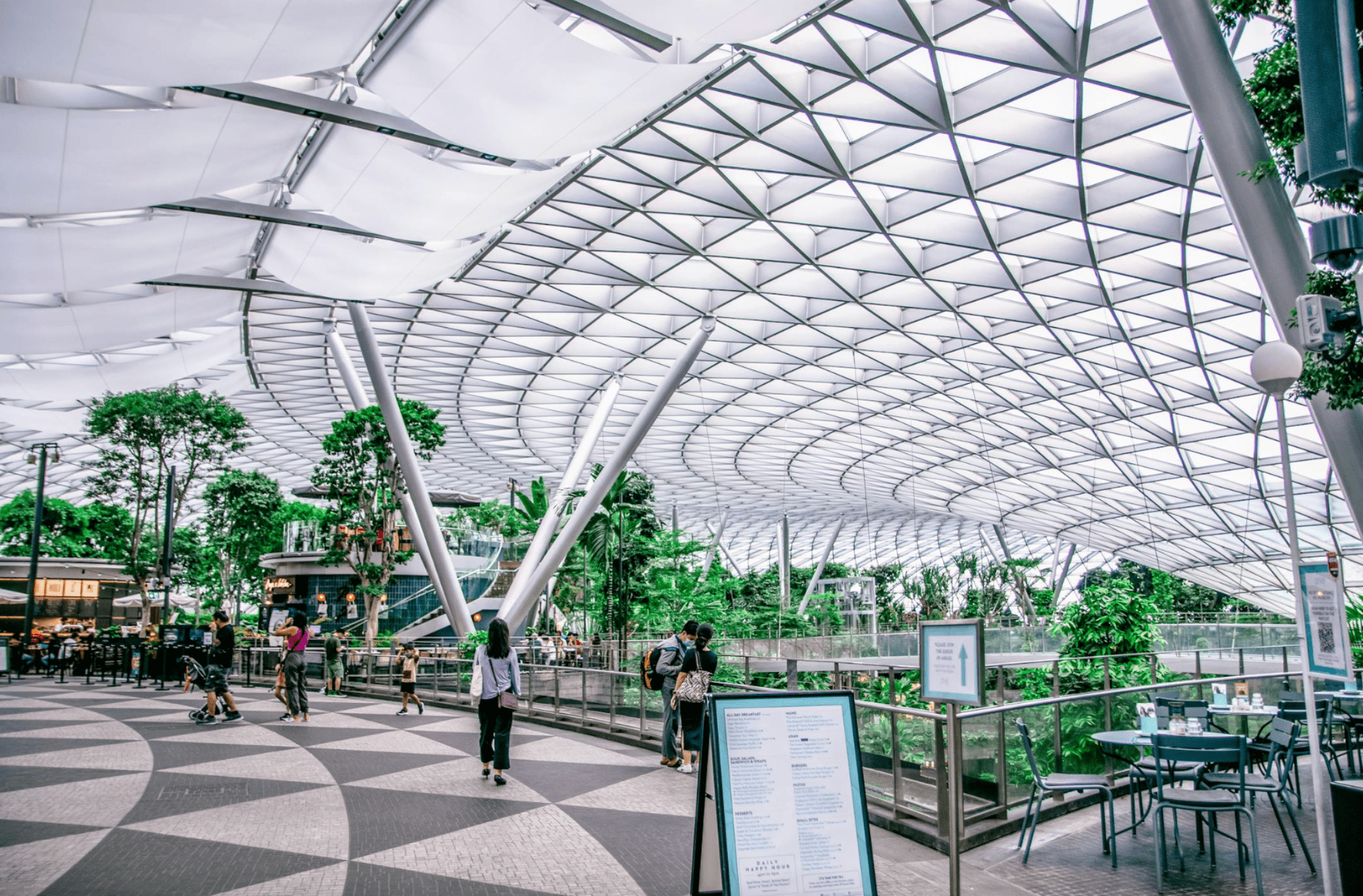
Image credit: Changi Airport
The 9,600 glass panels in the "Jewel" section allow for ample natural light. The airport also includes the Sunflower field - a children's play area - and various other attractions, like the Water Lily Pond and Hedge Maze that bring different natural worlds together under one roof.
2. The Amazon Spheres, USA
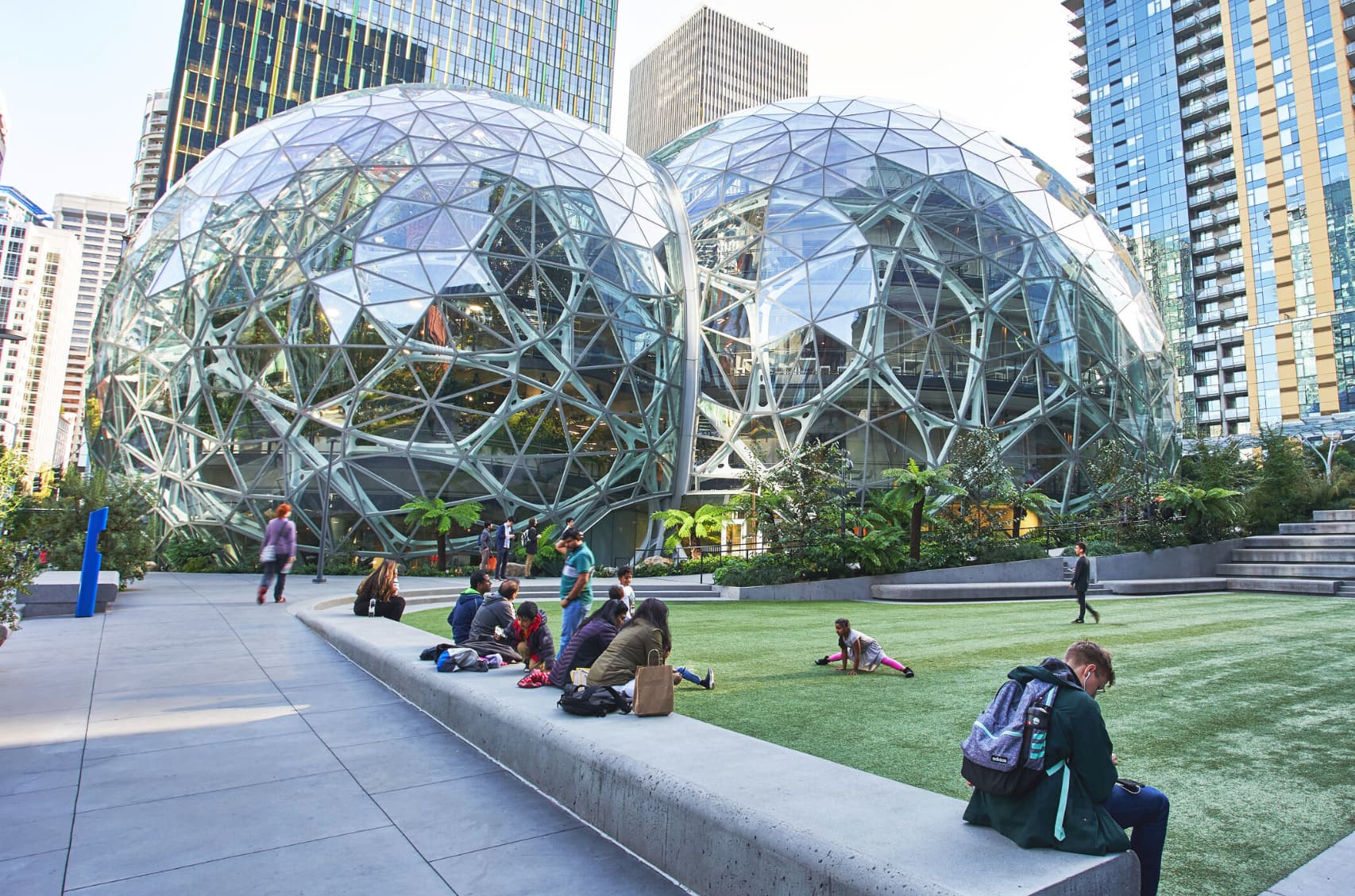
Three glass spheres in the heart of Amazon's Seattle campus house over 40,000 plants from more than 400 species. Employees work, meet, and think inside a living rainforest — the project is widely cited as one of the most ambitious corporate biophilic design projects in the world. Image credit: aboutamazon.com
These three glass domes that make up Amazon's Puget Sound headquarters in Seattle, USA, are filled to the brim with greenery, waterfalls and even fish. Visitors will find a living wall of 371 square metres containing 200 different plant species. The three domes mimic a rainforest, creating a unique working space for employees, or an awe-inspiring outing for visitors.
3. Bosco Verticale (Vertical Forest), Milan

The towers act as a vertical ecosystem, improving air quality, reducing urban heat, and providing residents with constant views of and proximity to nature.
Image credit: Stefano Boeri Architetti
The Bosco Verticale in Milan, Italy consists of two "vertical forest" buildings of 80 and 112 metres high, housing a total of 800 trees, 15,000 perennials and 5,000 shrubs. It houses up to 300 people. The apartment buildings were built to promote the flourishing of nature in an urban setting, and offers a habitat to various birds and insects, too. The trees contribute to a local microclimate that can filter pollutants and dust from the air and combat noise pollution. The buildings run on solar energy and a water recycling system.
4. Ruins Studio, Scotland

Image credit: © Sergio Pirrone via Lily Jencks Studio
This private home was rebuilt on the ruins of an old farm house in Dumfries, Scotland and was designed to retain many of the natural elements from the original building, including the stone walls. The house has large windows and several skylights, allowing in natural light and stunning countryside views. The majority of the interior materials are made from wood, glass and stone. The house is powered by solar energy.
5. Tanner Springs Park, USA

Image credit: Dreiseitl Consulting
This park in a residential neighbourhood in Portland, USA is a mixed-use leisure area built around a restored wetland. Years ago, a lake called Tanner Creek was drained and filled for railroad construction, but has since been revived as part of a government project. In fact, even stormwater runoff is directed back into the pond. The walkways, made from recycled basalt cobblestones, and the lawns are surrounded by the pond and its native vegetation, where the local ecosystem is flourishing.
Biophilic Design vs Biomimicry: What's the Difference?
This is the most common point of confusion, and the distinction is important.
**Biophilic design** is about *human experience*. It asks: how do we bring nature into the spaces people inhabit so they feel better, perform better, and connect to the living world?
**Biomimicry** is about *problem-solving*. It asks: what strategies has nature evolved over 3.8 billion years that we can apply to our design, engineering, or business challenges?
| Biophilic Design | Biomimicry | |
|---|---|---|
|
Core question |
How do we connect people to nature? |
What can nature teach us about solving problems? |
|
Focus |
Human wellbeing and space |
Functional design and innovation |
|
Outcome |
Nature-rich environments |
Nature-inspired solutions |
|
Example |
A living green wall in an office |
A ventilation system inspired by a termite mound |
The two are complementary — and some of the most powerful sustainable designs draw on both. A building might use biomimicry to design its structure (inspired by a bone's lattice efficiency) while applying biophilic design principles to its interior (living walls, natural light, organic materials). Source: Trellis / Terrapin Bright Green
Curious about the biomimicry side? Read our guide to what biomimicry really is or explore the best biomimicry examples.
How to Apply Biophilic Design
Whether you're designing a home office, a commercial fitout, or a large civic building, the following principles apply at every scale:
Start with light. Daylight is the most powerful biophilic element. Before adding any plants or materials, maximise access to natural light. Position key work and living areas near windows, add skylights where possible, and choose light-reflective finishes.
Add living plants intentionally. A single plant on a desk has measurable effects. A curated mix of species — varied in height, texture, and form — creates a richer sensory experience. Living walls bring the effect to a new scale entirely.
Choose natural materials. Timber, stone, bamboo, cork, and clay all bring tactile, visual, and even olfactory connections to nature that synthetic materials cannot replicate.
Design for prospect and refuge. Create spaces where people can see widely while feeling sheltered — a window seat with a view, a quiet alcove off an open-plan area, or a mezzanine with sightlines across the floor below.
Incorporate water. Even a small water feature — a wall-mounted ripple feature, a tabletop fountain — adds sound and movement that research consistently links to reduced stress and improved focus.
Use natural patterns. Fractals, organic textures, and nature-inspired geometries in floor coverings, wall treatments, and furniture bring the visual complexity of the natural world into spaces where live plants aren't always possible.
How to Learn Biophilic Design Professionally
Biophilic design is increasingly a career differentiator for architects, interior designers, urban planners, and sustainability consultants. Professionals who can apply it confidently are in growing demand as organisations commit to wellbeing-centred design standards.
We offer a dedicated Biophilic Design Masterclass — a self-paced course that distills the principles, research, and practical applications of biophilic design into a single, accessible programme. It's designed for working professionals, takes less than 10 hours to complete, and is backed by 10+ years of expertise in nature-inspired design and education.
For those wanting a deeper grounding in the relationship between nature, design, and innovation, the Biomimicry Practitioner Programme is a 6-month part-time journey that equips you to apply nature's strategies at a professional level — internationally recognised and endorsed by the Biomimicry Institute.
FAQs
What is the goal of biophilic design?
The goal is to strengthen the connection between people and nature within built environments — improving physical health, mental wellbeing, productivity, and quality of life by integrating natural elements, materials, light, and spatial experiences into the spaces we inhabit.
Is biophilic design expensive?
It doesn't have to be. Maximising natural light, choosing natural material finishes, and adding curated plant arrangements can be achieved at modest cost. Large-scale interventions like living walls or water features require greater investment, but even simple biophilic elements deliver measurable wellbeing benefits.
What are the 14 patterns of biophilic design?
Terrapin Bright Green's influential report "14 Patterns of Biophilic Design" identifies: visual connection with nature, non-visual connection with nature, non-rhythmic sensory stimuli, thermal and airflow variability, presence of water, dynamic and diffuse light, connection with natural systems, biomorphic forms and patterns, material connection with nature, complexity and order, prospect, refuge, mystery, and risk/peril.
Who coined the term biophilia?
E.O. Wilson, the Harvard biologist and naturalist, popularised the term in his 1984 book *Biophilia*, describing it as "the urge to affiliate with other forms of life." The application of biophilia to architectural design — biophilic design — developed through the subsequent decades.
Can biophilic design be used in small spaces?
Absolutely. Even a small home office benefits from a window plant, natural light, and organic material choices. Biophilic design scales from a desk to a skyscraper — the principles remain the same.
What are the 14 patterns of biophilic design?
There are 14 patterns that have been identified within biophilic design in the built environment, as set out masterfully in this report by Terrapin Bright Green. The report also explains the relationship of each pattern with the physiological, cognitive and emotional responses they elicit in humans.
Here is an overview of the 14 patterns.
- Visual Connection with Nature. A view to elements of nature, living systems and natural processes.
- Non-Visual Connection with Nature. Auditory, haptic, olfactory, or gustatory stimuli that engender a deliberate and positive reference to nature, living systems or natural processes.
- Non-Rhythmic Sensory Stimuli. Stochastic and ephemeral connections with nature that may be analyzed statistically but may not be predicted precisely.
- Thermal & Airflow Variability. Subtle changes in air temperature, relative humidity, airflow across the skin, and surface temperatures that mimic natural environments.
- Presence of Water. A condition that enhances the experience of a place through seeing, hearing or touching water.
- Dynamic & Diffuse Light. Leverages varying intensities of light and shadow that change over time to create conditions that occur in nature.
- Connection with Natural Systems. Awareness of natural processes, especially seasonal and temporal changes characteristic of a healthy ecosystem.
- Biomorphic Forms & Patterns. Symbolic references to contoured, patterned, textured or numerical arrangements that persist in nature.
- Material Connection with Nature. Materials and elements from nature that, through minimal processing, reflect the local ecology or geology and create a distinct sense of place.
- Complexity & Order. Rich sensory information that adheres to a spatial hierarchy similar to those encountered in nature.
- Prospect. An unimpeded view over a distance, for surveillance and planning.
- Refuge. A place for withdrawal from environmental conditions or the main flow of activity, in which the individual is protected from behind and overhead.
- Mystery. The promise of more information, achieved through partially obscured views or other sensory devices that entice the individual to travel deeper into the environment.
- Risk/Peril. An identifiable threat coupled with a reliable safeguard.
You can also dive in to Thermory's Six Elements of Biophilic Design here.
Good biophilic design often aligns with some of Life’s Principles adhered to in biomimicry, such as:
- Being attuned and responsive to the local environment where the building will be constructed, and sourcing local materials
- Using life-friendly chemistry when creating new building materials and interior products
- Being resource efficient, utilising existing materials and products, and using bio-degradable materials where possible
In Closing
Biophilic design is a great way to (re)connect humans and nature and to cultivate an appreciation for nature's genius. If you're ready to learn more about biophilic design, sign up for our Biophilic Design Course, hosted by biophilic design consultant Alexandra Bowen.
Reference: Header image of The Jewel at Changi Airport sourced from Safdie Architects via Billion Bricks

10 years to build, 10 minutes to read. This eBook is the essence of biomimicry.

This Biomimicry Short Course Set is trusted by 1,679+ Learners. PLUS you get a free Confluence ticket
Recent Posts