
The Complete Guide to Biophilic Design Courses (2026 Edition)
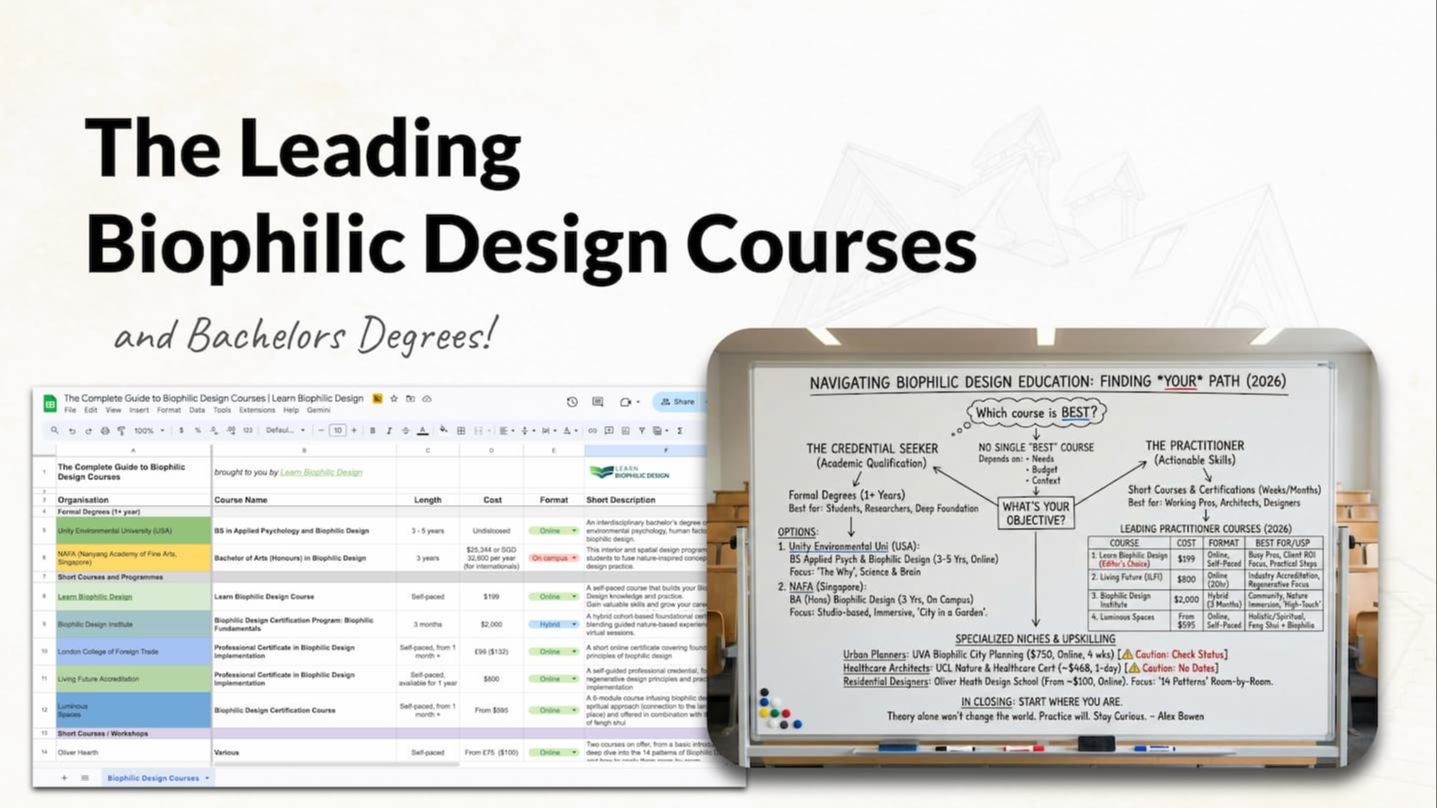
Are you considering expanding your biophilic knowledge, but feel unsure about where to start?
You've come to the right blog.
Biophilic design - the practice of designing spaces that (re)connect humans to nature—is quickly gaining momentum as the leading nature-forward approach in architecture and interior design. With the growing demand for experts and a collective need to improve well-being, the number of educational options has grown dramatically.
But which is the best biophilic design course?
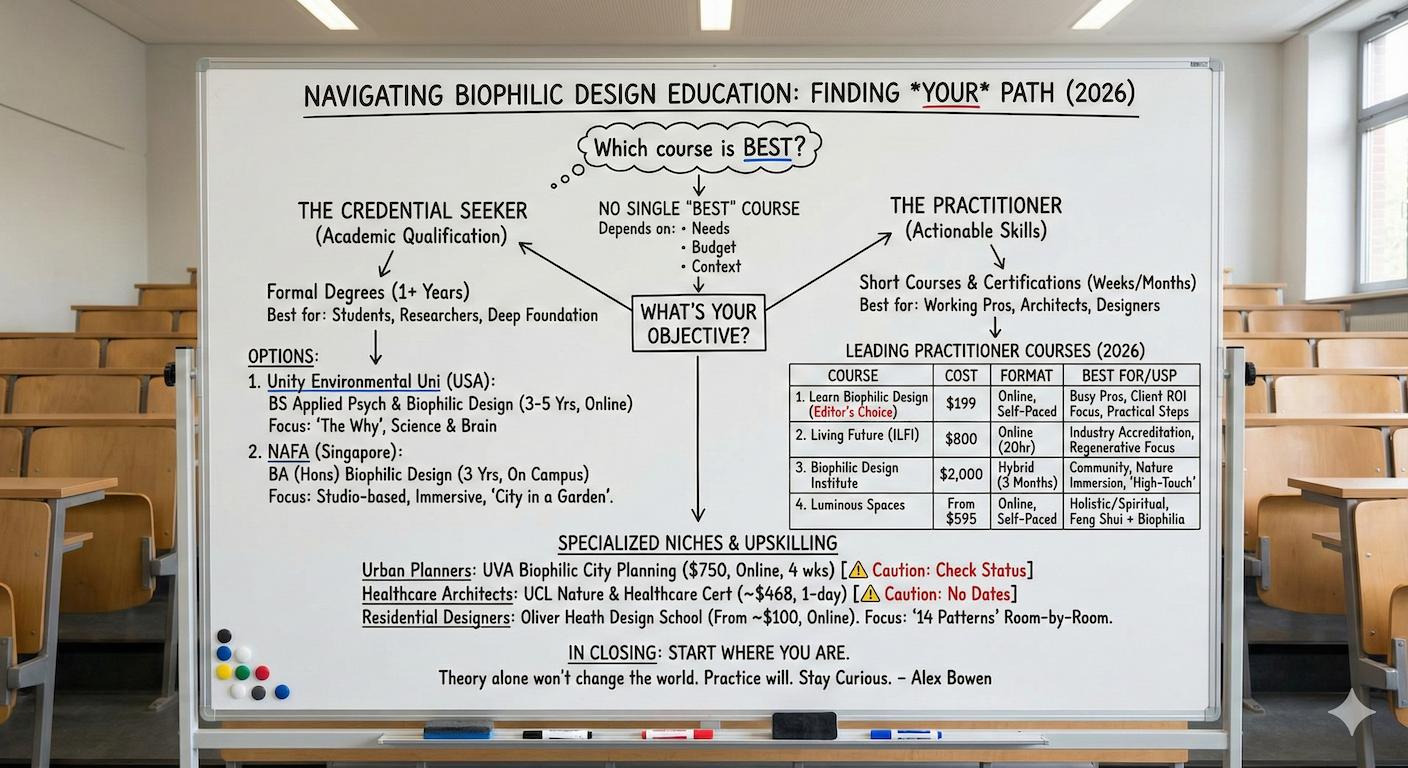
The inconvenient truth is, there is no single "best" course.
The right choice is defined by your individual needs, your budget, and your professional context. To help you navigate the options, we’ve taken a deep dive into the leading courses of 2026.
[ If you're looking for a side-by-side course comparisons, you can download the complete gSheet of all Biophilic Design courses here ]
Do you seek Qualifications or Experience, Grasshopper?
Before browsing the list, ask yourself: "What am I seeking to get out of this?"
In our experience, learners generally fall into two categories:
- The Credential Seeker: You need an academically recognized qualification for a specific job position (e.g., a Bachelor's or Master's degree).
- The Practitioner: You want practical understanding and experience to support your career or business, without necessarily needing a multi-year university degree.
By clarifying your objective, you can choose the path that best fits your function.
Part 1: The Practitioner’s Path (Short Courses & Certifications)
Best for: Working professionals, architects, and designers who need actionable skills now.
1. Biophilic Design Short Course – Learn Biophilic Design
Price: $199 USD (once-off)
Format: Online, Self-Paced
Best For: Architects, Interior Designers and working professionals focused on applying Biophilic Design
Link: Learn Biophilic Design
Editor’s Note: Okay, we’re biased, but hear us out.
In our research to build the Learn Biophilic Design platform (and beyond our architectural degrees and management of a 120,000+ strong design community), we purchased and studied many of the courses on this list. We noted what worked, and we saw what didn’t. This comprehensive list of all biophilic design courses was part of that research.
We found that many courses focus heavily on what biophilic design is (the theory), but miss who it’s for (the clients, home-owners and designers). That’s why we built the Biophilic Design course specifically for working professionals.
This course is for you if you are busy, short on time, and want to 'do the work' to attract clients who are willing to invest. The curriculum consists of three targeted modules:
- Introduction to Biophilic Design: The foundational science.
- The Multi-Faceted ROI of Biophilic Design: The business case you need to convince clients.
- Biophilic Design Framework and Patterns: Practical application steps.
You’ll walk away with a strong understanding of Biophilic Design thinking suited for the real world.
You can view the course curriculum and brochure here.
2. Living Future Accreditation - Professional Certificate in Biophilic Design Implementation
Cost: $800
Format: Online, Self-Paced, 20-hour program
Best For: Those seeking industry-standard accreditation.
Link: https://store.living-future.org/products/course-lfa
The International Living Future Institute (ILFI) is a heavyweight in the regenerative design space. Their self-guided professional credential focuses heavily on implementation. It bridges the gap between the high-level theory of the Living Building Challenge and the practicalities of design. If you are looking to align your practice with regenerative principles specifically, this is a robust option.
3. The Biophilic Design Certification Programme – Biophilic Design Institute
Cost: $2,000
Format: Hybrid and Cohort-based (3 Months) - blending guided nature-based experiences with virtual sessions
Best For: Learners seeking community and nature immersion.
If you learn best through experience rather than screens, this is your biophilic design course.
The Biophilic Design Institute offers a hybrid cohort-based certification. It blends virtual sessions with guided nature-based experiences. While the price point is higher, the value lies in the "high-touch" approach and the opportunity to network deeply with a specific cohort of peers.
4. Biophilic Design Certification Course – Luminous Spaces
Cost: From $595
Format: Online, Self-Paced
Best For: Holistic and spiritual design practitioners.

Free eBook
A Field Guide to Biomimicry
10 years to build, 10 minutes to read. Gain the skills to apply biomimicry to your business, projects and daily life.
Get the free eBook →Biophilia is science, but for many, it is also spirit. Luminous Spaces offers a 6-module course that infuses biophilic design with a spiritual approach - focusing on "connection to the land" and "spirit of place." Uniquely, this course is often offered in combination with the practice of Feng Shui, making it a distinct choice for designers focusing on energy and flow within a space.
5. Nature-Centered Design Through an African Lens
Cost: $100
Format: Online, Self-Paced
Best For: Architects and designers, sustainability professionals, students and anyone passionate about nature-centered African futures
For the past several years, Wangui Mwangi has been researching and sharing insights on biophilic design and Africa’s deep relationship with nature.Her work focuses on reconnecting modern African development with indigenous knowledge systems and nature-based design principles.
She created this course, which is part of her larger mission: To document, revive, and advance African biophilic knowledge for the future.
6. Habitarmonia Academy
Cost: €390/year
Format: Online, Self-Paced subscription, community orientated
Best For: Architects and designers, sustainability professionals, students and anyone passionate about nature-centered African futures
Habitarmonia Ecosystem is a community where designers, architects, researchers, and changemakers come together to explore biophilic design, regenerative practices, and life-centered leadership.
Part 2: The Academic Path (Formal Degrees)
Best for: Students and researchers seeking deep, foundational knowledge (1+ Years).
7. Bachelor of Science in Applied Psychology and Biophilic Design – Unity Environmental University (USA)
Length: 3-5 Years
Format: Online, Self-Paced
Depth Score: 6/5
This is one of the most comprehensive programs available. Unity Environmental University has positioned biophilic design not just as an art, but as a science. By housing the degree within Applied Psychology, the curriculum explores the cognitive and physiological effects of nature on the human brain. It is an interdisciplinary bachelor’s degree suited for those who want to understand the "Why" at the deepest possible level.
8. Bachelor of Arts (Honours) in Biophilic Design – NAFA (Singapore)
Cost: ~$25,344 per year (International)
Length: 3 Years
Format: On Campus
Singapore is often cited as a "City in a Garden" making it the perfect backdrop for this degree.
The Nanyang Academy of Fine Arts (NAFA) offers a studio-based program where interior and spatial design meet nature-inspired concepts. Unlike the online options, this is an immersive, face-to-face experience, equipping students to fuse concept with physical practice.
Kindly note that NAFA has these entry requirements for this BA in Biophilic Design.
Part 3: Specialized Courses and Specific Niches for Biophilic Designers
Best for: Specific niches and quick upskilling.
- For Urban Planners: The University of Virginia (UVA) offers the Biophilic City Planning & Design Program ($750). It's a four-week programme that explores the science and planning strategies behind biophilic cities. It's hosted online (once per week for four weeks), and global. <-- Caution: this looks like it may have been discontinued.
- For Healthcare Architects: University College London (UCL) offers a Nature and Healthcare Design Certificate (approx. ~$468). This 1-day intensive explores biomimicry and biourbanism applied specifically to healthcare contexts—a critical growth area for the industry. <-- Caution: this course doesn't have a start date
- For Residential Designers: The Oliver Heath Design School (from ~$100) offers visually rich courses on the "14 Patterns of Biophilic Design," teaching you how to apply them room-by-room.
The Ultimate Guide to Biophilic Design Courses: From Free Workshops to Master’s Degrees
In my research, I created this research document... and thought best to share. You can download the complete list / spreadsheet here.
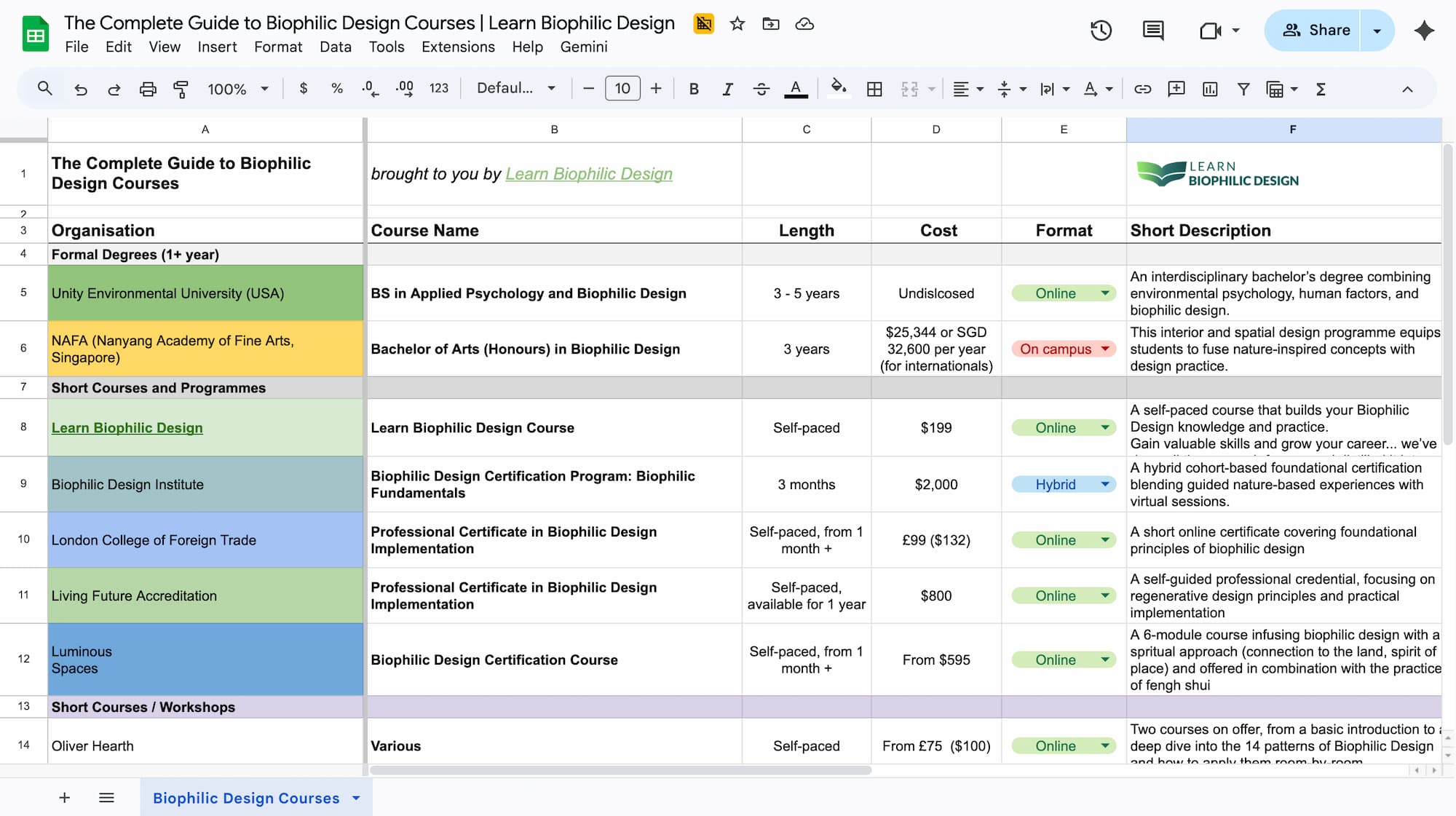
So you are considering expanding your biophilic knowledge, and perhaps you're comparing prices, duration, formats across the internet. With the growing demand for experts and a collective need to improve well-being, the number of educational options has grown dramatically. If you're looking for a side-by-side course comparisons, you can download the complete gSheet of all Biophilic Design courses here.
In Closing: Start where you are.
Diversity, networking, and life-long learning are the pillars of a resilient career.
The world of biophilic design is growing rapidly, and new information is surfacing all the time.
Thus you may do more than one course... but before you get ahead of yourself - what do you need now?
Remember: Theory alone will not change the world. It is only through practice and application that we will move toward a thriving, nature-connected future.
Whether you choose a 3-year degree to become a researcher, or our practical Learn Biophilic Design short course, the most important step is the first one.
Start where you are.
Stay curious.
Alex

Alexandra Bowen
Cofounder and Course Instructor of the Learn Biophilic Design Short Course
About me: I bring a unique blend of experience, with a degree in Environmental Design, a background in program management and community engagement, combined with experience in startups and at companies like Google. I am the founder of the Biophilic Design Community, dedicated to bringing together professionals and enthusiasts passionate about integrating nature into the built environment. As an expert in biomimicry and nature inspired design methods, I specialize in consulting on biophilic and nature-inspired design strategies. I am also a Biophilic Design consultant, speaker and writer.
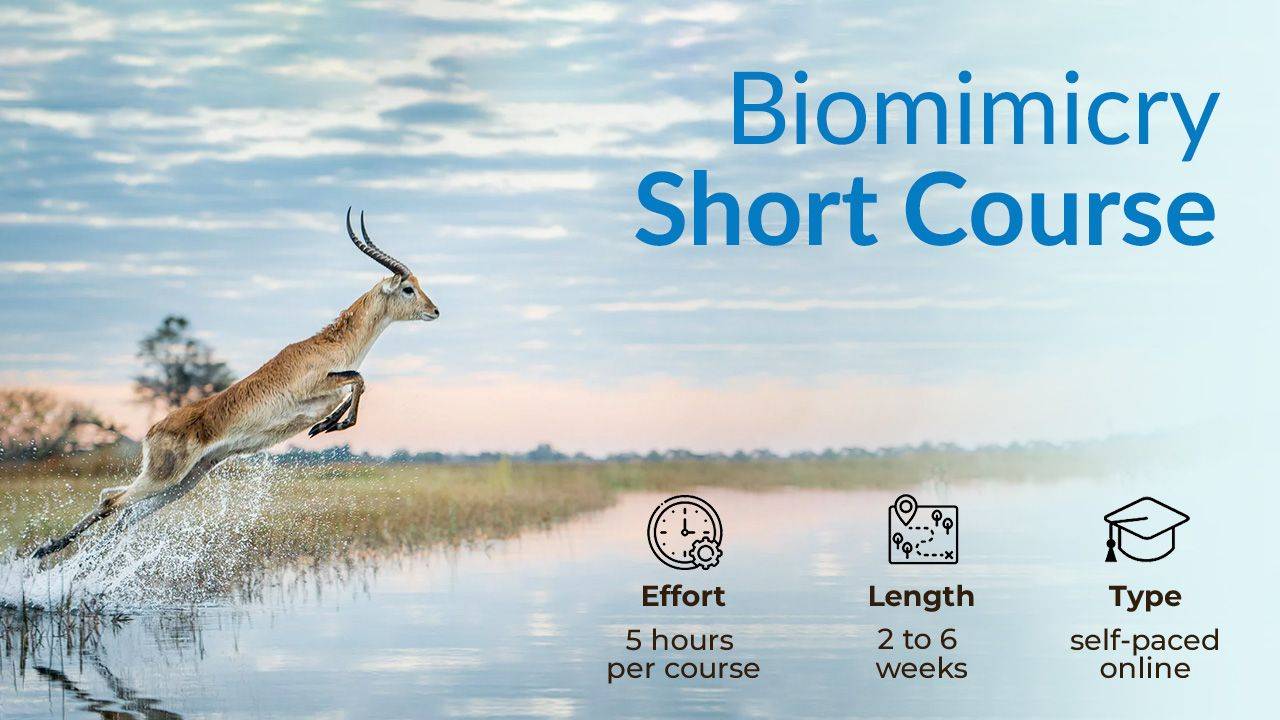
Online Short Courses
Start your biomimicry journey
The depth of a degree, the ease of a TED talk. 10 years to build, 10 hours to complete.
Explore the short courses →
Here’s the one biomimicry course you need that turns these examples and insights into a skill set. Trusted by 1,679+ Learners. Three self-paced courses, one price. $198 US.
10 years to build, 10 minutes to read. This eBook is the essence of biomimicry.
Recent Posts