
Biomimicry and Kids: What You Need to Know (and Book Recommendations)
Today, you and I are kickstarting the Biomimicry Generation.
Where kids don't just learn about nature, they learn from nature.
Biomimicry is more than just a science; it's a way of seeing.
When we talk about biomimicry and kids, we often focus on the "cool factor" - how a kingfisher inspired a bullet train or how sharkskin leads to bacteria-resistant surfaces.
But if we want to empower the next generation of designers, we need to go deeper than just sharing fun facts and biomimicry examples.
Today, we're diving into what you actually need to know about teaching biomimicry to children, why I view it as a "startup" mindset, and the best books to get them started on thinking like nature.
My Controversial Take: Biomimicry is a lot like Entrepreneurship
Teaching biomimicry to kids is akin to teaching them how to launch a startup. In the professional world, biomimicry is most effective when it is applied to a specific niche - think biomimicry and treating wastewater, biomimicry and architecture, or biomimicry and textiles.
For kids, the magic happens when we move away from abstract theory and toward problem-solving. The heart of a successful startup is finding a problem worth solving. Similarly, the hardest part of practicing biomimicry isn't just finding the biological inspiration; it's defining the challenge.
The Challenge of the "Big Challenge"
Suggested Image: A visually impactful image of ocean waves or a dense forest to represent big environmental themes. (Pexels Search: "Nature background" or "Ocean waves")
When kids start with biomimicry, they naturally gravitate toward "saving the world". They want to tackle plastic pollution or global warming . While these are noble starting points, they aren't well-defined challenges. They are too big to "solve" with a single leaf or a bird's wing .
With that said, I do believe that biomimicry has the power to 'save the world', just one project and passionate child at a time. To truly learn the Biology to Design framework, kids need to bring the challenge home.
Educator Tip: Instead of solving plastic pollution ask: How would nature design with waste? By narrowing the scope, we help kids move from being nature fans to nature-inspired innovators .
Three Must-Read Biomimicry Books for Kids
If you want to spark that "Aha!" moment, you need the right resources. These books bridge the gap between biological wonder and human engineering.
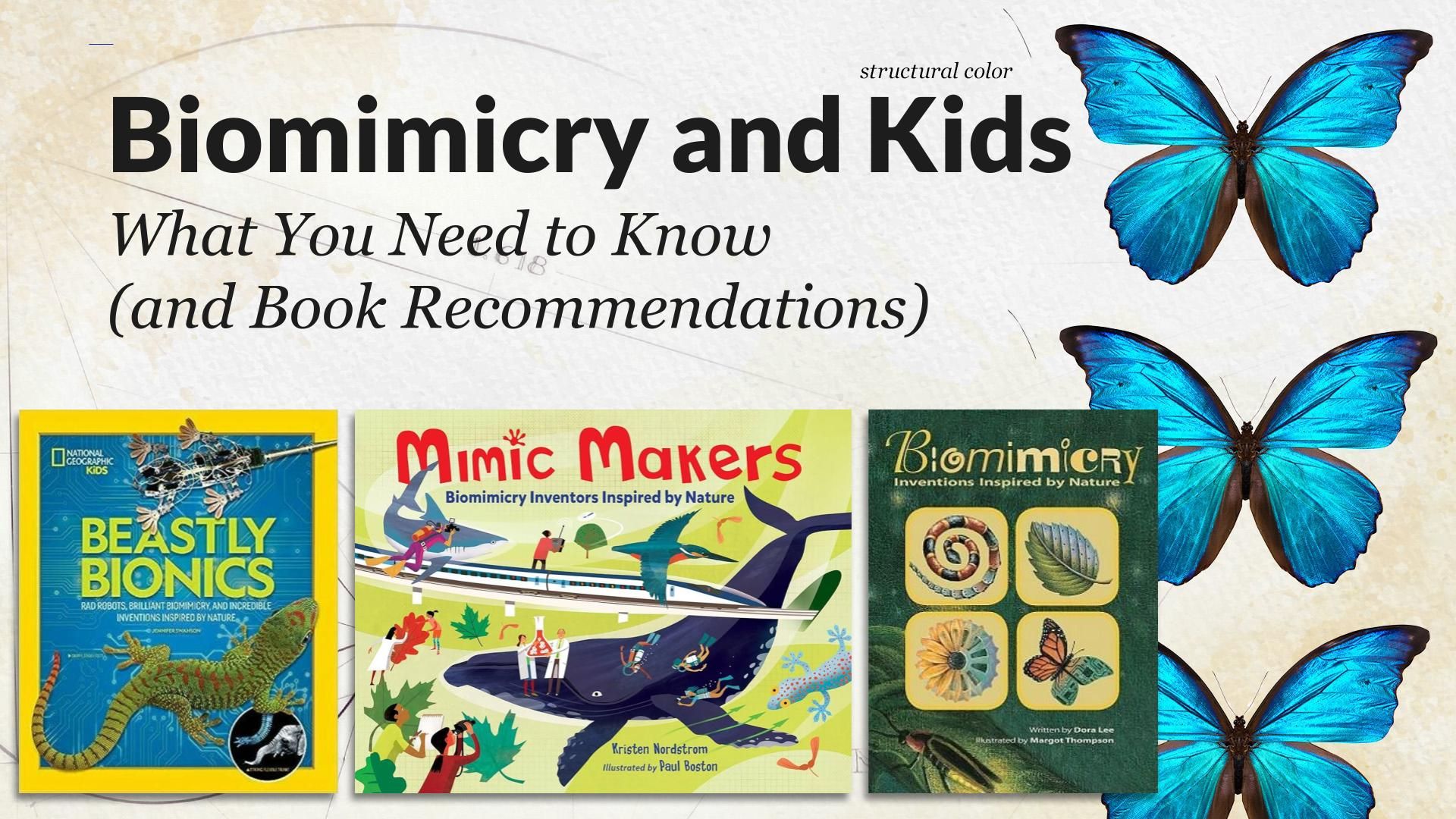
1. Biomimicry: Inventions Inspired by Nature

This is the ultimate primer for budding scientists (ages 8-12) who are ready to see the world differently.
Instead of just listing inventions, it presents an intriguing collection of specific environmental challenges that humans have faced and the biological breakthroughs that offered sustainable solutions. It takes young readers on a fascinating journey, from observing the unique shape of a flower that inspired the iconic Burj Khalifa, to understanding how a bird's beak became a model for the world's fastest trains.
It's an incredibly empowering read that makes a compelling case for 'copying nature' and shows kids that sustainable innovation is within their reach.
🌾 Biomimicry Book: Biomimicry: Inventions Inspired by Nature
🪲 Biomimicry Organisms: Flowers (Burj Khalifa inspiration), Birds (Bullet train inspiration)
🎯 Why we like it: Compels kids to see nature as an inventor, makes complex engineering and science accessible, and sparks curiosity about sustainable solutions.
✏️ Written by: Dora Lee (Illustrated by Margot Thompson)

Free eBook
A Field Guide to Biomimicry
10 years to build, 10 minutes to read. Gain the skills to apply biomimicry to your business, projects and daily life.
Get the free eBook →2. Mimic Makers: Biomimicry Inventors Inspired by Nature

This beautifully illustrated book is perfect for showing kids the human side of biomimicry. Instead of just focusing on the end product, it profiles ten real-life scientists, engineers, and designers who observed nature to solve complex problems.
It walks students through the actual process of biomimicry - from that first moment of curiosity in the wild to the final stages of engineering. It's an incredibly empowering read that shows kids that anyone who pays attention to nature can be an inventor.
🌾 Biomimicry Book: Mimic Makers: Biomimicry Inventors Inspired by Nature
🪲 Biomimicry Organisms: Kingfishers, geckos, humpback whales, and maple seeds
🎯 Why we like it: Encourages observation, highlights the STEM invention process, and teaches creative problem-solving
✏️ Written by: Kristen Nordstrom (Illustrated by Paul Boston)
3. Beastly Bionics: Rad Robots, Brilliant Biomimicry, and Incredible Inventions Inspired by Nature
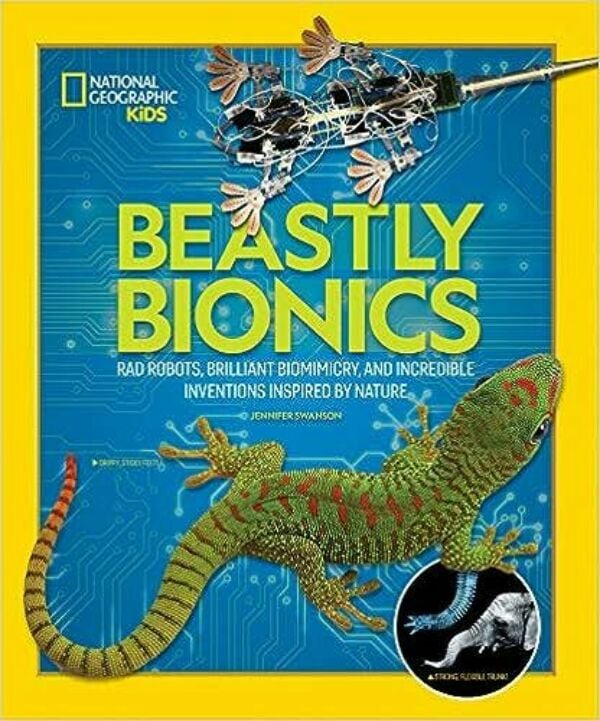
If your students or kids are obsessed with robots and technology, this is the ultimate book! Published by National Geographic Kids, Beastly Bionics explores the intersection where biology meets cutting-edge robotics and medical devices. It is packed with high-energy facts, vivid photography, and real-world engineering challenges that educators can easily adapt into classroom activities. It perfectly illustrates how nature is the ultimate blueprint for the technology of the future.
🌾 Biomimicry Book: Beastly Bionics: Rad Robots, Brilliant Biomimicry, and Incredible Inventions Inspired by Nature
🪲 Biomimicry Organisms: Pangolins, octopuses, mosquitoes, and more
📍 Where: Accessible everywhere (National Geographic Kids)
🎯 Why we like it: Bridges biology with advanced robotics, bionic tech, and medical breakthroughs
✏️ Written by: Jennifer Swanson
Author Highlight: Dorna Schroeter
If you are looking for a guide in the world of biomimicry education, look no further than Dorna Schroeter. Dorna is a master at translating complex ecological processes into design principles that kids (and adults!) can grasp. Her work focuses on "living technology" - teaching us that we don't just live on Earth, we are part of a functional, living system.
Here are her must-reads for the classroom:
-
How an Idea from Nature Changed Our World: The Story of Velcro: This is the classic "entry point" for biomimicry. It tells the story of George de Mestral and the burrs on his dog's fur. It's the perfect example of how a simple walk in the woods can lead to a global industry.
-
The Story of Eco-Machines: Designed for middle schoolers, this book explores the work of John Todd. It explains how we can use "living technology" (like plants and bacteria) to treat wastewater and solve human problems.
-
We Are One: A User's Guide for Young Earthlings: A beautiful exploration of biodiversity and ecosystems, framing sustainability not as a chore, but as a way of life. The book's interactive questions throughout the text encourage deeper discussion and invite further exploration.
How to Get Started in Your Classroom
Suggested Image: Kids collaborating over a drawing or a prototype. (Pexels Search: "Kids drawing" or "Students collaborating")
If you're an educator, start small. Don't just look at nature; ask what nature does
-
Identify a local problem: (e.g. "How do we stay cool on the playground?")
-
Ask "How does nature do this?": (e.g. "How does a termite mound stay cool?")
-
Sketch a solution: Encourage them to be "Nature Entrepreneurs"
The future belongs to those who can bridge the gap between biology and design.
Let's start teaching them today.
Wild regards
Alistair
PS - I just purchased Dorna's new book: We Are One: A User's Guide for Young Earthlings - I highly recommend this book, and the imagery is stunning!
Whenever you're ready, there are 3 ways Learn Biomimicry can help you:
→ 1. The Biomimicry Short Course Set: Join 1,679+ learners, from 41+ countries and start your biomimicry journey today. This short course set will give you a solid understanding of the biomimicry basics.
→ 2. The Biomimicry Practitioner Programme: Accelerate your career and gain the skills you need to apply biomimicry to your career and daily life. This 6-month (part-time) mentored programme will enable you to practice biomimicry confidently.
→ 3. The Biomimicry Educator Programme: Build your own biomimicry curriculum, course or workshop series. Purpose-built for educators, this programme will empower you to successfully integrate biomimicry into your teaching environment.
Online Short Courses
Start your biomimicry journey
The depth of a degree, the ease of a TED talk. 10 years to build, 10 hours to complete.
Explore the short courses →
Here’s the one biomimicry course you need that turns these examples and insights into a skill set. Trusted by 1,679+ Learners. Three self-paced courses, one price. $198 US.
10 years to build, 10 minutes to read. This eBook is the essence of biomimicry.
Recent Posts